
Share This Post Today!


Inis Cathaig Lighthouse, Clare, Ireland

This lighthouse is located on the island of Inis Cathaigh. The island does not have any residents. The last residents left in 1969. The island has a small visitor center and is run by the Office of Public Works.
Straw Island Lighthouse, Aran Islands, Ireland
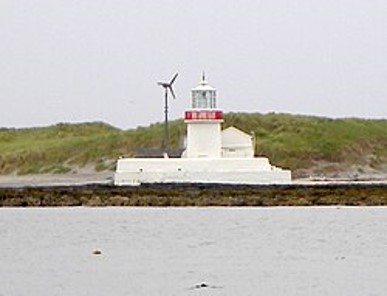
This lighthouse is an active lighthouse that was originally completed in 1878. It is one of four lighthouses on the Aran Islands and all four were completed before 1900. This lighthouse stands at 11 meters tall.
*Feel free to send us your photos of Lighthouses to be featured in our weekly market observations.
Market pullback
On Monday morning, technology stocks and markets as a whole pulled back after Anthropic’s CEO called for a slowdown in AI development and emphasized safety first. Elon Musk and OpenAI’s Sam Altman share these views. Three of the biggest faces in the AI race essentially agree that their firms should stop racing each other for technological supremacy.
Anthropic’s technology warning statement does not call for an outright slowdown in spending and model training; it calls for safety and more research on regulation. However, that did not stop investors from selling first and asking questions later on Monday morning.
On another topic, The Financial Times reported that Anthropic told its investors that the company would be profitable for a second straight quarter. The firm reportedly is realizing 80% gross margins before accounting for revenue from distribution partners and the cost of training its models.
Sam Altman also hinted that OpenAI was unlikely to IPO this year. Investors have been hoping that both OpenAI and Anthropic would follow SpaceX by going public this year. We are looking forward to these IPOs as they enhance the transparency of these firms and their financials at a time when they have become some of the largest and most powerful companies in the world. Right now, we are just basing our thoughts on reports and select information.
These AI worries come a week after a former Anthropic researcher warned that AI could kill us all by the end of the decade. AI worries are real, and investors are now actively monitoring them after essentially ignoring them over the last few years.
Before we get any pushback from our well-informed readers, markets were also adversely affected on Monday by higher oil prices once again and worries regarding a Federal Reserve interest rate hike. The probability of an interest rate hike surged on Friday after it was reported that inflation came in at 3.4% in August. Odds for a rate hike jumped to 90% on Friday and sat well above 80% into Monday. Numerous Wall Street banks are now predicting the FED will raise interest rates on Wednesday and potentially raise them once more later this year. There are also growing fears that inflation could persist and lead to the FED raising its benchmark rate by more than 0.5% over the next year, which could severely affect consumers and investors. According to the CME FED Watch Tool, investors believe there is a 31% probability that the FED will increase interest rates by 1% or more by June 2027.
In terms of inflation data, August’s headline number came in line with economists’ expectations. However, stripping out volatile items like food and energy, the core CPI came in at 0.3% for August versus expectations of a 0.1% increase. Energy drove the headline number higher, with gasoline rising 27.4% and fuel oil rising 52% over the last year.
FED Chair Kevin Warsh has expressed a commitment to getting inflation back to 2%, the Fed’s target inflation rate. At the Fed’s last meeting, Warsh stated that if numbers do not improve, the FED has some work to do – indicating that he is open to a rate hike. If the FED and Warsh do raise rates, it will likely put the FED on a collision course with the President and his administration.
As traders priced in an interest rate hike, U.S. interest rates continued their ascent, with the 10-year Treasury rate hitting 5% for the first time since 2023 on Monday and to its highest level since 2007 on Tuesday morning. The 10-year yield has increased by more than 60 basis points over the last three months, and many expect that trend to continue.
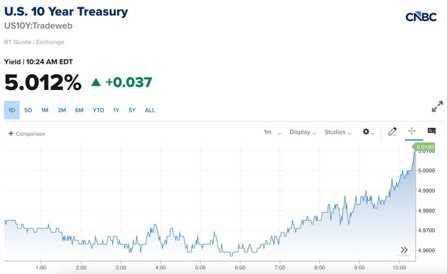
Source: CNBC
The comments above were made on Monday, September 14th, before the FED met and made its monetary policy decision. We will briefly comment on the Fed’s decision below:
On Wednesday afternoon, the FED did what everyone was predicting and raised rates for the first time in three years. This was not surprising, as inflation remains an issue and the labor market looks stable. The decision from the Fed was unanimous amongst its members. The bigger question for investors is whether more hikes are on the horizon. The majority of the Fed’s members only see one more rate hike this year. The dot plots were much more spread-out next year, with the median being one or two rate hikes more in 2027. Higher for longer, it is.
In terms of Warsh’s press conference, he stated that the economy can handle this, as the economy appears strengthened with earnings, new hiring, and investment all moving in the right direction. Warsh also stated that the Fed has a role in sustaining economic progress in America.
Western commitment to metals continues
Over the last few years, there has been a broad and consistent effort by Western countries to secure, diversify, and invest in base and rare earth metals production. This effort has been led by the U.S., who continue to look to diversify away from Chinese production.
This week, the U.S. Department of Defense announced a $450 million investment in a small domestic tungsten producer, Elmet Group. Tungsten is a critical metal essential for many military hardware applications. Elmet Group shares surged on the news. Its shares made their debut in public markets in April after an IPO. The company is the only domestic producer of tungsten.
The company stated that it received the investment to increase domestic tungsten production and decrease America’s reliance on Chinese supply chains for tungsten. In 2025, China accounted for 80% of global tungsten production. China’s share of production has increased significantly over time, while the U.S. has not mined significant amounts of tungsten in over 30 years.
Elmet will immediately receive $200 million, while the remaining amount will be received if Elmet reaches certain milestones. The funds that they will receive have already been roughly allocated for various purposes, including upgrading plants, building a refining facility, and restarting a major tungsten deposit in Nevada. In its press release, Elmet stated that it will sell up to $2 billion in tungsten deposits to the government over the next 5-7 years to support national emergency reserves.
The details on this deal are similar to a deal struck between the U.S. government and MP Materials earlier this year. This investment is the latest by the U.S. government, who has invested billions into various companies in order to expand domestic metals production. The Trump administration says it has signed or approved 160 critical minerals deals totaling more than $40 billion since January 2025.
Even if all global planned rare earth refining projects come online as scheduled, China’s market share in rare earth refining is only projected to fall to 70%-73% from 85% today by 2035, according to the IEA.
We expect this trend to continue and hope the Canadian government does the same thing by investing in Canadian projects and prioritizing securing the reliable supply of base and rare earth metals.
Musk teases merger
During a recent podcast, Elon Musk hinted at merging his two businesses, SpaceX and Tesla. Musk has long hinted at this as he thinks he would be able to create more value for shareholders and create synergies. The firms both have AI ambitions, and consolidating them would pool computing power, talent, and data. Musk also likely wants to increase his own control of his firms, as he only owns 20% of Tesla voting shares but 80% of SpaceX’s super voting shares. At Tesla, he has faced shareholder scrutiny and faces independent directors. At SpaceX, he does not. We will also say that Musk’s own ego is likely driving this, as it would create one of the world’s largest companies and add to his legacy.
SpaceX shares are down 5% since their first closing price this past spring, and Tesla shares are down 17% year-to-date.
Musk’s appearance on the All-in podcast covered a variety of topics, including AI data centers in space and government regulation.
Neither Tesla nor SpaceX responded to comments from news outlets after Musk’s podcast appearance.
We will say that, as of now, these are rumors, and Musk seemed more playful on the podcast than serious, but we do not think a merger is completely off the table. The tough part for us is to predict what valuation this deal gets done at and what price the takeout offer will be at. For now, we are not sure but will be watching it very closely.
Clarity Act fails
On Tuesday the Clarity Act, a key cryptocurrency regulation bill, failed to pass in the Senate. This caused cryptocurrencies and crypto related stocks to pull back slightly but according to Wall Street it is not a fatal blow to crypto as a whole. Cryptocurrencies and crypto related stocks have rebounded over the last few weeks after lagging for most of the first six to seven months of 2026.
Image created with Grok
For those who do not know, the Clarity Act is a proposed federal bill that establishes a formal market structure framework for cryptocurrencies and digital assets. It divides oversight between the SEC and the Commodity Futures Trading Commission.
Republican leaders released a revised version of the bill on Sunday to address Democrat concerns regarding public officials profiting from crypto ventures. However, the changes were not enough in the eyes of the Democrats, who remain concerned about public officials, including the President, profiting from crypto ventures. The bill needs 60 votes to pass and only got 50 in Tuesday’s Senate vote. According to Morgan Stanley, the act is not dead, but the short-term odds of this act being passed have fallen sharply. Tuesday’s failure likely means negotiations will not happen until next year as the Senate heads for a midterm election recess in mid-October.
Even if the bill eventually passes the Senate, it faces steep hurdles before becoming law. The bill will first need to clear the House and eventually President Trump. This bill passing would be significant for the entire cryptocurrency industry and could potentially be the trigger that attracts long-term capital. However, many experts believe regulatory momentum might need to be established outside of Congress due to its divisiveness. This year, the SEC proposed allowing startups to sell as much as $75 million of tokens without registering, while the CFTC recently approved the first-ever Bitcoin perpetual futures in the U.S.
Needham’s analyst for cryptocurrencies stated that this vote ends market structure legislative work for 2026 but does not adversely impact current exchanges who will be business as usual. He went on to state that the pullbacks for a few of the exchanges that would have benefited from this bill passing could present strong investment opportunities, as many of the stocks in the sector are well off their highs and are relatively cheap. “Nothing about the failed vote changes the current underlying businesses, and we view this as a buying opportunity,” said the analyst.
We do not have public exposure to crypto-related companies but continue to follow the sector closely to see if there are attractive risk-adjusted opportunities for our investors. Historically, we have avoided many of the names due to their inherent volatility and our relatively conservative approach to public equity markets.
A new issue: data centers
Data centers have been at the center of financial markets and economic discussions for a few years now as companies build out their AI infrastructure and networks. Originally, consumers were all in on AI as they only saw the benefits from increased productivity and innovation, but as power prices have risen in certain areas, consumers are now growing angry at the firms who are building these data centers and those who are approving them.
These data centers that power AI utilize a massive amount of power and are being built in more rural areas. This is straining the power grid in these local communities. It has also raised the cost of power for many consumers that are near these data centers that are not off the main grid.
This has become a very big issue and has caused some Republican candidates to cross Trump’s stance on data center construction. Trump completely supports data center construction and has been a huge advocate from the beginning. His support stems from data centers’ role in expanding America’s AI capabilities and the strong stock market that has come with AI. Trump has flip-flopped his comments regarding Republican opposition to data centers.
A few of the Republican candidates for this election have made data centers a key piece of their platform, stating that the local people should have the biggest voice when it comes to these AI data centers and not the companies building them or federal officials. According to MarketWatch, 61% of Americans somewhat or strongly oppose data centers in their area. Just four months ago, that number was only 49%. At the end of the day, these data centers are providing the most benefits to a few companies and billionaires and are a strain for the local community.
University of Pennsylvania Professor Matt Levendusky expects the republicans to continue to oppose these data centers and expects AI and data centers to be a key discussion point in politics moving forward and expects every 2028 presidential candidate to have a platform on how they will handle AI and even regulate it.
What we are watching next week?
Next week is a relatively slow week in markets, with the FED making its decision this past Wednesday, inflation reports coming out over the last week, and limited earnings. Nonetheless, we will be watching a few things, including Costco’s earnings, the Trump-Xi summit, and a few FED Governor speeches, which could give us further guidance on the future monetary policy decisions that the FED will make.
MacNicol & Associates Asset Management
September 18th, 2026