
Bull Rock Lighthouse, Dursey Island, Ireland

This lighthouse was built in 1888 off the southwest coast of Ireland. The original lighthouse was lit on 1866, but a 1881 storm broke the structure. The lighthouse can only be visited by boat tours.
Loop Head Lighthouse, Loop Head, Ireland

This lighthouse is located off the west coast of Ireland on the north side of the mouth of the River Shannon. The lighthouse station was built in 1854 and currently stands at 23 meters tall.
*Feel free to send us your photos of Lighthouses to be featured in our weekly market observations.
Berkshire rallies
On Monday, Berkshire Hathaway shares rallied to near all-time highs after a strong earnings report. Previous highs were reached more than a year ago, before former CEO Warren Buffett announced he would step down at the end of 2025.
During the second quarter, Berkshire’s operating profits after taxes increased 6% to $12 billion. This figure topped estimates and was driven by Berkshire’s industrial businesses.
During the quarter, the company also increased its share repurchases, as it bought back approximately $4.5 billion in shares. The pace at which management bought back shares is the most aggressive ever for the company and signals that management sees value in shares at these levels. During the first quarter of this year, Berkshire only bought back $235 million worth of shares. Berkshire was also a highly active equity buyer in the second quarter. They bought $23 billion in stock, including $10 billion in Alphabet shares (already disclosed). Berkshire’s 13F will be released next week, where we will see the other purchases. Berkshire is slowly deploying more and more of its dry powder under new CEO Greg Abel’s leadership. The company’s cash position decreased from $380 billion to $365 billion during the second quarter.
Berkshire book value continued to rise this quarter, increasing by 3% due to earnings and strong equity market performance.
Many sell-side analysts raised their price targets for Berkshire shares. We expect more and more investors to turn bullish on the company moving forward post-Buffett. We think this quarter, and a few more, will go a long way for Abel in the eyes of investors.
Disclaimer: MacNicol & Associates Asset Management holds shares of Berkshire Hathaway across various client accounts.
Intel ups its offering
On Monday, Intel announced that they were increasing its equity offering to $20 billion. Originally, Intel was offering $15 billion in an equity raise. Intel said that the underwriters of the deal have a 30-day option to purchase $2.25 billion in common stock.
This equity issuance upsize is Intel taking advantage of its current share price and investor sentiment in terms of the overall AI and semiconductor trade. Shares are up more than 150% this year despite dropping nearly 20% over the last three months. Shares moved lower by approximately 4% on Monday after the announcement. Over the last year, Intel shares have greatly outperformed its industry competitors, including AMD, Nvidia, and TSMC. The offering closed on Wednesday.
KeyBanc’s analyst stated that this raise will support an expansion in terms of CPU requirements and support future demand. This raise is positive for Intel and the industry as it signals consistent and sustainable demand. On Intel’s most recent earnings call, they raised their capex estimate for 2026 by 11%. The company also posted its fastest revenue growth in nearly 15 years.
According to Bloomberg, investor demand for this deal was very strong, with nearly one-third of investors who placed orders not receiving shares. According to the report, there were more than $100 billion in orders, mostly from institutions.
Intel’s investors include Nvidia, SoftBank, and the U.S. government. We think the smart money saw this deal and jumped on it while many retail investors rushed to sell when they read the headline “dilution”. For now, we remain on the sidelines when it comes to Intel, but we continue to watch it closely from a fundamental standpoint.
This year’s equity offerings in the U.S. have been dominated by companies riding the AI wave as companies hike their spending. Alphabet has led the way with a current $85 billion raise, while other firms, including Oracle, have fundraising plans that are quite elevated and are north of $10 billion.
Private equity and sports
In recent years, strategic investors have begun to focus their attention on professional sports. These strategic investors have included the richest people in the world, sovereign wealth funds, pension plans, family offices, and private equity sponsors. Some sports teams have even gone public as owners look to spread ownership and capitalize on fan loyalty. It is truly a new world in sports.
The investment thesis for institutional investors in sports is driven by scarcity, recession-proof fan loyalty, and soaring valuations. In recent years, the value of these teams has historically outperformed traditional financial markets. Before we go any further, we will make one caveat: when we say professional sports, we are talking about the NFL, NBA, NHL, MLB, and elite-level soccer leagues across the world. We are not as familiar with lower-value leagues/franchises.
We bring this up this week due to a recent announcement from the company that owns one of the world’s most iconic teams, the New York Yankees. Yankee Global Enterprises inked a deal with alternative asset manager Apollo Sports Capital, the sports arm of alternative investment manager Apollo. Yankee Global Enterprises’ assets include the Yankees, the YES Network, and stakes in New York City FC and AC Milan. According to the terms of the deal, the Yankees will receive $2.6 billion (in a mixture of debt and equity). The Yankees will utilize the capital to retire a large portion of its existing debt and to pursue new ventures. The ownership percentage for Apollo is not yet known, but the current owner of the Yankees, Hal Steinbrenner, will remain the team’s general partner and his family will maintain full control. However, we do know that Apollo’s ownership is no higher than 15%, as the MLB restricts private equity ownership in its league at 15%. According to Forbes, the New York Yankees team value was $8.5 billion as of March 2026 with $710 million in revenue.
Apollo Global Management is a New York-based asset manager with over $1 trillion in assets under management. Last year the firm’s sports arm announced the acquisition of soccer team Atletico de Madrid, and a minority investment in Wrexham AFC. As more and more institutions dive into professional sports, we expect deal sizes to grow. This is Apollo’s first big step into the U.S. sports market; do not expect it to be its last. We also presume its competitors will be diving headfirst as well (if they have not already).
It is unclear as of today how the deal will change the day-to-day operations of the Yankees, but for now both the Yankees and Apollo seem thrilled with the closing of this deal. We will warn Yankees fans and sports fans as a whole: private equity is not always sunshine and rainbows. Private equity firms often look to increase efficiencies through cost-cutting, added leverage, and new systems. In sports, private equity has a mixed history as some transactions have worked out, but some have not. In terms of the transactions that have not worked out, it usually begins with ownership increasing ticket prices, alienating local and loyal fans, cutting their costs, and commercializing the product. We are not stating that this will happen; we are simply warning our readers: do not be surprised if sports change when more and more private market managers enter the arena.
July’s CPI
On Wednesday morning, the U.S. Bureau of Labor Statistics released July inflation data. The data reflected some easing in terms of inflation, with the July number coming in line with expectations. The Consumer Price Index climbed to 0.1% in July, equating to an annual gain of 3.4%, slightly lower than June’s 3.5%. Energy price declines in July provided some ease for the CPI as the CPI index for energy declined by 1.5% in July after falling 5.7% in June. Overall, energy prices have risen 14.7% over the last year. Food prices rose at a lower rate than expected in July while shelter inflation remained soft in July at 0.1%, the same figure as June. When you strip out volatile items like food and energy, prices rose 2.5% over the last year (down slightly compared to June and May’s numbers).
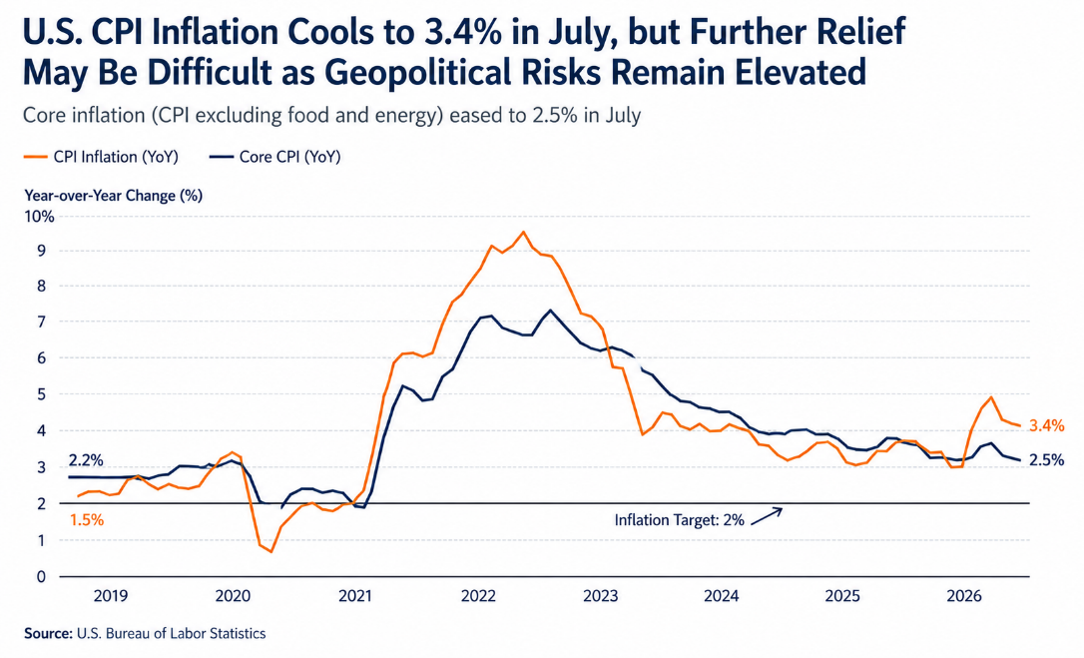
The annual inflation rate has remained well above the Fed’s target for over five years. Higher for longer is a thing, and we think it could continue for the foreseeable future. We think affordability remains an issue for middle America and there will likely be less discretionary spending ahead. There is a reason more and more middle-income earners are dipping into credit and their savings; wage gains are being erased by sticky and persistent inflation. The FED has a real storm on their hands.
We do not think this softer reading is enough to settle the debate over a Federal Reserve interest rate hike in September. For starters, the FED will get more inflation readings before they meet; inflation reaccelerating in August is on the table. Secondarily, inflation remains well above the FED’s target and could remain in that area with the Strait of Hormuz remaining closed. We also believe U.S. tariffs and AI-driven demand for technology equipment and software are also major risk factors that are impacting prices. The risk of elevated inflation remains high in our eyes moving forward (not just quarter to quarter).
The markets’ reaction to this CPI print was initially muted in our eyes, with investors remaining worried regarding a potential September rate hike, or one later in the year / at the start of 2027. According to Bloomberg, analysts are pushing rate hikes further out according to bond yields, but they are still expected due to the overall inflation trend.
Our take as of now – the FED will hold rates in place for another meeting and make their eventual decision later in the fall. This prediction assumes there are no shocks to the system, and the CPI remains at this level for August’s reading.
Franco-Nevada earnings
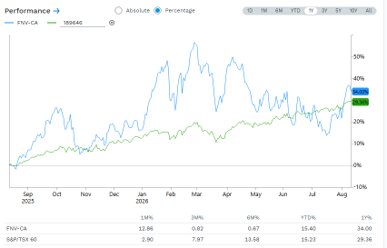
On Tuesday, Franco-Nevada Corporation reported its second-quarter fiscal-year earnings. The company, which manages a gold-focused royalty and stream portfolio, slightly missed revenue and earnings-per-share estimates, sending shares lower on Wednesday by more than 2%. Despite this pullback, shares rallied through the middle of the day and are up more than 15% year-to-date (as of August 12, 2026). Despite its share price volatility, FNV shares have outperformed the TSX 60 over the last year:
Source: FactSet
The firm’s revenue came in at $580.9 million, and adjusted EPS was $1.81 (U.S. dollars). Despite the quarterly misses, revenue and EPS increased by 57% and 46%, respectively, year-over-year. The firm stated that they are on track to reach the upper end of their 2026 annual guidance (in terms of gold-equivalent ounces). Management expects production to pick up in the second half of the year compared to the first half due to new contributions from recent acquisitions, and boosted output from Candelaria, Tocantinzinho, and Cote Gold. Strong figures were driven by elevated gold and silver prices, increased production, and higher margins. The firm’s revenue, operating cash flow, and net income in the first half of 2026 all set records.
In terms of energy revenues, Franco-Nevada benefited from oil and natural gas volatility, with oil revenue rising to $78.8 million, a 20% increase YoY. Management presumes a 12% increase in oil revenues compared to their guidance if prices remain near $80 per barrel (currently assumed WTI price is $70 per barrel). This trend for Franco further diversifies their revenue stream.
Management stated they had $4.3 billion have $4.3 billion in available capital as of June 30th, which includes cash, credit capacity, and marketable securities. The firm remains debt-free. Management stated that their deal pipeline remains strong as they continue to analyze a range of deals and stated that their portfolio is well positioned for continued growth. During the second quarter, the firm acquired 3 royalties on projects, and a portfolio of royalties from Victoria Gold Corporation for assets in Canada and the U.S.
In terms of valuation, Franco-Nevada trades on the upper end of its peers in terms of earnings, cash flow, and EV/EBITDA. The company remains in the best position compared to its peers to acquire assets due to its elevated cash level. We think its valuation is justified due to Franco-Nevada’s leading margins, strong management team, and diversified asset base. We also believe Franco-Nevada’s past and forward growth justifies this valuation.
Disclaimer: MacNicol & Associates Asset Management holds shares of Franco Nevada Corporation across various client accounts.
SpaceX news
On Wednesday, SpaceX shares rose by their second-most-ever (excluding the first two days it traded) after Elon Musk held an all-hands meeting for SpaceX employees. The meeting was not the sole driver of this massive day for SpaceX shares. The broader AI market had a very strong day on Wednesday as well. SpaceX shares have had a strong rebound over the last five days after selling off to begin August when nearly one billion shares unlocked, allowing early shareholders and employees to cash out. This share unlock caused serious selling pressure as SpaceX’s float expanded quite significantly.
In the meeting, Musk was characterized as very optimistic. Musk went on to state that AI-based internet traffic will be 1000x human traffic in five years. He stated that SpaceX must be the leader in AI as the world will be overwhelmingly AI and robots. He also went on to say that Starlink had 22 million mobile subscribers. This surprised investors as Starlink reported 12 million fixed wireless customers at the end of the second quarter. Street analysts believe the 10 million difference is likely Musk referring to partnerships Starlink has with existing wireless companies.
We continue to follow SpaceX closely as it continues to dominate the market in terms of news and headlines. It is truly a fascinating story.
What we are looking at next week
As earnings season draws to a close, investors’ focus will shift toward incoming macroeconomic data, with growth and price stability remaining marquee themes for markets. Inflation readings from Canada, Japan, and the UK will offer important clues on the trajectory of monetary policy and the resilience of household demand across developed economies. In China, retail sales and industrial production will be closely watched for confirmation of whether domestic consumption and manufacturing activity are gaining momentum. Together, these releases should help shape expectations for global growth, interest rates, and the broader market outlook.
MacNicol & Associates Asset Management
August 14th, 2026
Download in PDF format: