
East Brother Island Light, Richmond, California

This lighthouse is located north of San Jose on the coast of California. The lighthouse was built in 1874 and stands at 48 feet tall. This wooden tower lighthouse was eventually automated in 1969.
Los Angeles Harbor Light, Los Angeles Harbour, California

This lighthouse was built in 1913. The lighthouse is one of few lighthouses in the U.S. that emits an emerald green light. The lighthouse is on the National Register of Historic Places.
*Feel free to send us your photos of Lighthouses to be featured in our weekly market observations.
Buying the dip
As gold prices have pulled back, many investors have taken the opportunity to add exposure or initiate positions. We think some investors have woken up to the fact that gold belongs in portfolios, as it provides numerous benefits when combined with traditional assets. Central Banks across the world are also adding gold to their balance sheets, and at record rates. Central Banks across the world are prioritizing gold and rotating out of U.S. dollar and Euro assets. We think that trend will continue as Central Banks see those major currencies losing value due to inflation, debt levels, and selling pressure. Beyond that, governments around the world have seen what Russia experienced after invading Ukraine. Western countries have seized approximately $300 to $350 billion in Russian central-bank assets and made them inaccessible to the country. Why would other central banks, especially those more aligned with Russia, allow that to happen to themselves moving forward?
That is where gold comes in. It hedges more than just inflation and uncertainty; it hedges sanctions, frozen asset accounts, the exclusion from certain payment systems, diplomatic disputes, and funding restrictions. We think that is why many central banks have been net buyers of gold in recent years. This chart below shows the largest central bank buyers of gold last year. There is no bloc, no region, or no currency that is shared by the countries. They are all purely betting on higher prices and want a hedge away from traditional assets. These high-conviction buyers are not worried about the price that they are buying at; they are purely seeing asymmetry in global financial markets and want gold.
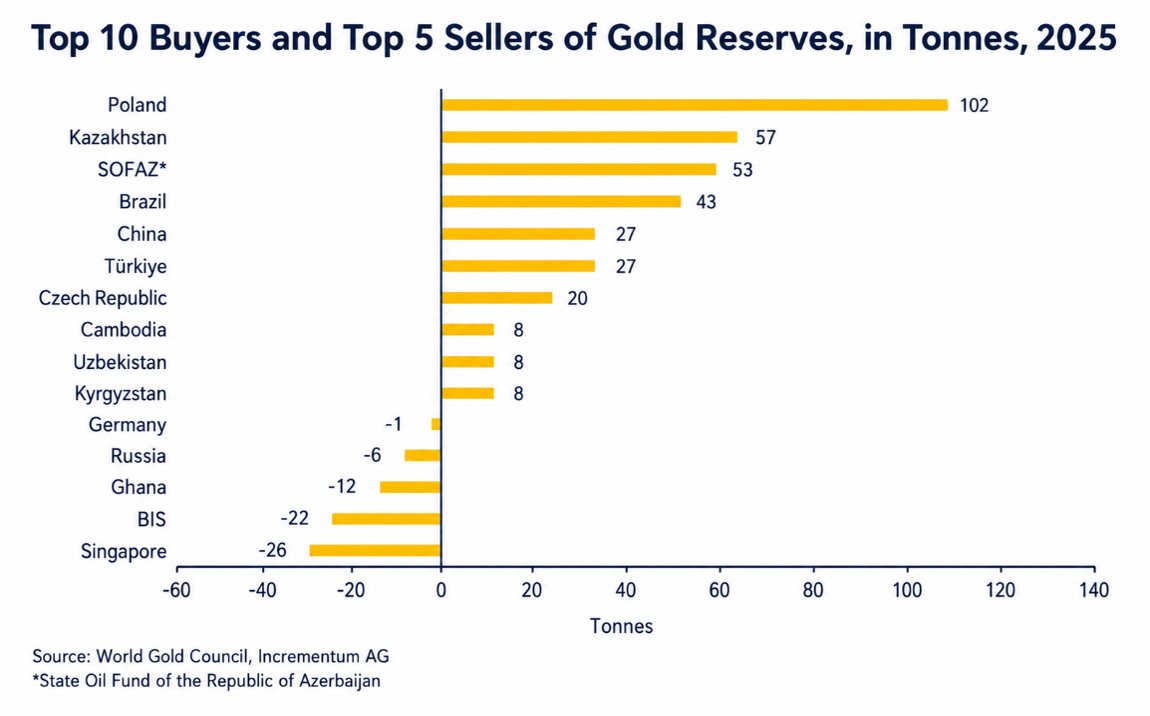
We expect this trend to continue all across the world, especially as major currencies around the world continue to lose some of their value due to a blend of inflation, uncertainty, and government debt levels (which continue to balloon). According to the IMF and Department of the Treasury, gold now accounts for more Central Bank FX reserves (approximately $5 trillion) than Foreign official Treasury holdings (approximately $4 trillion) as of the end of 2025. Just 2.5 years prior, gold accounted for half the holdings Treasury holdings did. Obviously, the trend change was impacted by the price increase gold has had over the last year, but it has also been impacted by rotation and prioritization by many Central Banks on gold rather than USD or Euro assets (the two largest Central Bank reserve currencies in the world).

Image created by Grok
Disclaimer: MacNicol & Associates Asset Management holds gold instruments including ETFs, stocks, and mutual funds that hold physical gold across various client accounts.
Room to run
As earnings continue to expand and corporations continue to beat earnings estimates, markets have continued their melt-up. According to FactSet data and Goldman Sachs Global Investment Research, U.S. stocks are expensive at 21.2x forward earnings but are nowhere near bubble territory. At the same time, emerging market equities are near a twenty-year low when it comes to forward price-to-earnings ratios (10.5x). The only other major group that is trading at near twenty-year lows is Asian-Pacific ex. Japan equities, which are currently trading at 11.5x forward earnings.
We think this data should push investors to look for exposure outside of the U.S. There are highly attractive opportunities available to investors that are not historically expensive.
The run that markets have gone on has led many to believe that we are in a bubble. We are not sure if we are yet in bubble territory but rather believe that we are likely due for a setback after a multi-decade run that has been historic. U.S. markets have roared in recent years; they have dominated global equity markets and led many investors to believe that markets only go up. We think this is a real risk factor in today’s markets, especially as everyone continues to go all in and “buy the dip”.
The reason valuations seem not to be at historic levels in the U.S. is due to strong earnings growth and elevated guidance from companies and sell-side analysts. Artificial intelligence has rerated the U.S. market; if this does not last and earnings growth slows, what happens next? The market will either become even more expensive, or it will pull back sharply.
Obviously, all of this is a forecast, and we are not making a timing bet on this happening. We are purely stating that investors should be ready for something like this and should be positioned accordingly. Hope is not a strategy; preparation is. Many investors have been trying to time the market perfectly by rotating into cash, but timing the top is almost impossible, and investors suffer from cash drag where their portfolio underperforms due to a large allocation to cash or cash equivalents. We avoid the cash drag on our investor portfolios due to our MacNicol Safe Harbor Fund, which provides portfolio insurance to unit holders through deep out-of-the-money puts through a U.S. hedge fund which has been at the forefront of tail protection for over twenty years. The portfolio insurance hedges tail risk and allows us to remain nearly fully invested despite elevated valuations in today’s market, a potential AI bubble, and other market risk factors plaguing global financial markets today.
Disclaimer: MacNicol & Associates Asset Management operates a Canadian fund for a tail risk hedging hedge fund. The strategy is not suitable for all investors, and this is not a security or strategy recommendation.
Rising bond yields
Global bond yields continued to rise this week as investor fears regarding inflation continued to rage on, with the Middle East crisis on the minds of many investors. Borrowing costs for many major governments around the world have hit their highest level since the 2008 financial crisis. On Monday, Japan’s 10-year yield hit a three-decade high, France’s 10-year yield hit its highest level since June 2009, Germany’s 10-year yield hit its highest level since 2011, while the U.S. 30-year yield hit its highest level since 2007. This is not yields rising in emerging or frontier markets; it’s the world’s largest economies and bond investors tell us something. Yields could be on the rise.
The ongoing Middle East crisis pushed oil prices higher by more than 6% last week, and it rose even further to begin this week after President Trump threatened to bomb Oman if the country gets in the way of ending the Iran war. We bring this up because it is unlikely that we will get a resolution anytime soon; thus, we expect inflation to remain top of mind when it comes to investors.
Investor fear regarding interest rate hikes across the world has plagued markets this year as investors seek a higher rate of return on government debt. For those of you unfamiliar with bond pricing, when yields rise, bonds decrease in price; they move in an inverse direction.
We think most of the increases in yields are due to inflation worries and rate hike fears paired with debt levels, which continue to hit new highs across the world. The U.S. debt level is expected to hit $40 trillion by the end of August – more than double what it was a decade ago. Beyond those factors, we also believe that reallocation is driving part of this yield increase trend across the world. According to a few analysts, some allocators have rotated capital away from government bonds into bonds from hyperscalers and AI companies. Not only are these investors adding risk to their portfolios, but they are also decreasing their portfolio diversification as those same companies typically account for a massive portion of investor equity exposure.
Image created by Grok
Despite these interest rate increases; the air has not been taken out of the tires of equity markets. According to Bank of America’s Global Fund Manager Survey published Tuesday indicated the highest allocation to stocks in nearly five years, with investors betting on AI investment, earnings growth, and a steady U.S. economy. The survey also indicated the highest number of respondents forecasting a boom in the U.S. economy. According to the survey, bond yields are now working their way up on the list of concerns for investors, rising to number two on the biggest concerns for investors, sitting below worries regarding an AI bubble.
We are glad more fund managers and investors are watching yields but still believe that the market is underprepared for even higher rates and potentially a few interest rate hikes from the FED and other central banks if inflation remains sticky. We hope for your sake you are not long, long-dated bonds. Our exposure to fixed income remains on the short end of the curve due to those major risks.
Canadian inflation rebounds
This week, Statistics Canada released its July inflation data as the underlying number hit 3%, up from 2.8% in June, a tick above Economists’ expectations. Global energy volatility driven by global conflicts was primarily to blame for the increase. In July, most of the taming of global energy prices in June was undone after ceasefire talks between the U.S. and Iran broke down.
Gas prices in Canada were up 25.7% year-over-year as of July, up from 20.5% in June. Another driver of July’s inflation rate was the FIFA World Cup, which pushed flight, hotel, and travel costs in July (Economists expect these pressures to unwind starting in August). Despite the increase in inflation in July, many economists, including the deputy chief economist at Desjardins, believe it is not enough for the Bank of Canada to change course. The same Economists also believe inflation is tracking below 3% in August due to energy prices moving lower.
The July inflation numbers are the Bank of Canada’s last look at price data before its next interest rate decision on September 2nd. The Bank of Canada has held rates steady for six straight decisions. According to LSEG data and analytics, odds sat at 99% for an interest rate hold as of Tuesday evening for September’s monetary policy decision from the Bank of Canada.
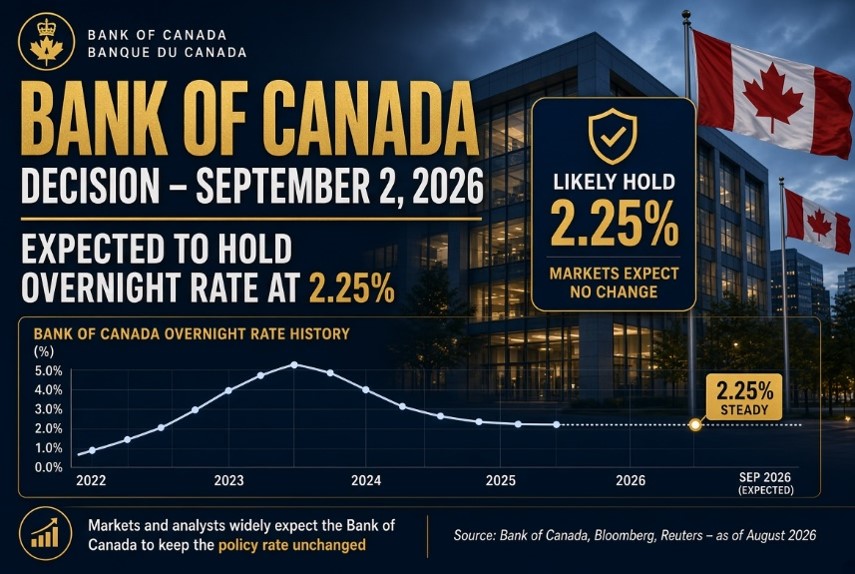
Image created by Grok
Street Economists stated that the Bank of Canada has some time before they need to rush and make a decision on interest rate policy. CIBC’s senior Economist stated that policymakers have plenty of time to gauge how oil price fluctuations and the tariff situation will resolve.
Canada was set to be hit with fresh Trump tariffs on Wednesday but got a 13th-hour 3-day extension to complete negotiations. According to Trump’s social media, the two sides had a deal but needed to complete negotiations as of this writing. Prime Minister Carney did not speak of a deal but stated that there had been substantial progress between the sides in a statement made on Tuesday.
Canada was set to be hit with broad-ranging 50% tariffs which would have applied to hundreds of products worth more than $28 billion. The tariffs would have impacted affordability in Canada, and many businesses in northern border U.S. states which often depend on sales north of the border. Fresh tariffs would certainly reaccelerate inflation in Canada and perhaps lead to an eventual interest rate hike from the Bank of Canada.
We are not going to make a prediction when it comes to a trade deal, as predicting President Trump’s actions comes with great difficulty. Instead, we will warn Canadians that the implementation of these tariffs paired with current tariffs poses a significant risk to economic growth, north of the border. We already have the slowest-growing economy in the G7 when it comes to productivity; this could make it even worse. We hope Carney and the rest of the Canadian contingent can get something done!
Quality AI name
Our last piece this week covers a company we have talked about a handful of times in this publication’s history, Analog Devices. For those of you unfamiliar with the name, the company is a Massachusetts-based semiconductor company that specializes in chips that let electronic systems sense, measure, convert, process, connect, and control physical signals. We have brought the company up this week because they reported earnings on Wednesday morning.
The firm reported better-than-expected quarterly earnings, revenue, and forward guidance. The earnings report sent shares higher and curbed some investor jitters about AI infrastructure stocks. Adjusted EPS jumped to $3.45 from $2.05 a year ago, and revenue surged by more than 40% and beat consensus estimates by $100 million (according to FactSet). The firm’s revenue growth was led by data center and industrial offerings. During the quarter, $1.7 billion was returned to shareholders through a blend of dividends and share repurchases ($4.2 billion over the trailing twelve months). Analog also reported extremely strong cash flows and growing margins this quarter.
In July, the firm completed its acquisition of Empower Semiconductor in an all-cash deal for $1.5 billion. The firm expects revenue contribution in fiscal year 2027. Empower’s integrated voltage regulator technology and capacitors can reduce data center power consumption by 10-15%. Management stated that many of the integration costs of this acquisition have already been reported by the firm.
In terms of guidance, management forecast for the fourth quarter adjusted EPS to be between $3.71 and $4.01 and revenue to be $4.3 billion versus Wall Street forecasts of $3.54 per share and $4.08 billion for revenue. The firm also guided its operating margin to 52% for the fourth quarter.
The firm’s favorable product mix, higher manufacturing utilization, and pricing power make us believe they can sustain these industry-leading margins moving forward. We think they are structural advantages, not cyclical swings.
We continue to like Analog Devices in the AI industry as it provides technology upside at a reasonable price. The central thesis for Analog Devices comes down to the firm being a diversified, high-margin, cash-producing semiconductor firm that takes less valuation and technology risk than many of the big names in the AI industry. ADI management also provides strong returns to shareholders in the form of share repurchases and dividends, something not common in the AI industry. We also like ADI for its disciplined management, as it reiterated a focus on balancing capex spending while trying to maintain current margins. Although shares have become more expensive over the last year, we continue to like ADI in the technology industry for the reasons outlined above.
We look forward to reviewing ADI’s next quarter earnings report and believe the firm can continue delivering strong results in today’s market.
Disclaimer: MacNicol & Associates Asset Management holds shares of Analog Devices (ADI: NYSE) across various client accounts.
What we are looking at next week
Markets enter next week with a few major forces in focus: the Canadian-U.S. tariff negotiations, Canadian bank earnings, and a series of U.S. economic releases that could influence Federal Reserve monetary policy. For investors, the banks remain an important proxy for the Canadian economy. In terms of trade negotiations, investors remain heavily focused on the proposed duties by President Trump that could affect $28 billion of Canadian goods. New tariffs could reaccelerate inflation, but a deal could ease the minds of consumers and investors.
MacNicol & Associates Asset Management
August 21st, 2026
Download in PDF format:
The Weekly Beacon August 21 2026 US