
Share This Post Today!


Trwyn Du Lighthouse, Penmon, Wales

This lighthouse marks the passage between two islands of Wales. The lighthouse was first constructed in 1838 for under $12,000. You can park near the lighthouse to visit the area. The current lamp was converted to solar power in the 90s.
Skokholm Lighthouse, Pembrokeshire, Wales

This lighthouse is located on a small island near Southwest Wales. The small island is a site for special scientific Interest and is owned by a division of the government. The island was the first bird observatory in Wales. The lighthouse was constructed in 1916.
*Feel free to send us your photos of Lighthouses to be featured in our weekly market observations.
Steel earnings forecasted to be strong in 2027
Early this week, Cleveland-Cliffs and Steel Dynamics reported their latest quarterly earnings. Overall sentiment from the releases was strong. Cleveland-Cliffs reported before the market opened on Monday. The firm beat street estimates for EBITDA, which jumped by more than 4 times year-over-year. Higher steel prices drove this increase in profitability where benchmark steel prices averaged $1,250 per metric ton during the last quarter versus $850 last year. Currently, steel prices are even higher, sitting near $1,350 per metric ton.
Management stated that 50% tariffs implemented by the Trump administration helped support the domestic industry by raising prices and reducing imports. The firm forecasts that 2027 adjusted EBITDA will exceed $4 billion, well above Wall Street forecasts of $2.5 billion. This forecast is a significant improvement from the firm’s last earnings call. Management stated that firms in the U.S. are realizing the importance of a reliable domestic supply chain. This realization has led to newly signed contracts for Cleveland Cliffs moving forward. Cleveland Cliffs also expects $715 million in EBITDA in the fourth quarter versus a Wall Street average estimate of around $700 million. The firm reaffirmed $3.2 billion in liquidity and reaffirmed its target net debt to EBITDA below 2.5x by mid-2027. The firm continues to reduce its debt driven by free cash flow and property sales and expects a major reduction in the fourth quarter.
This strong guidance from Cleveland-Cliffs led shares higher on Monday morning by more than 15%. Shares are now up 3% year-to-date as of Monday, which significantly lags the performance of other U.S. producers including Steel Dynamics and Nucor.
Steel Dynamics reported its third-quarter earnings at market close on Monday. The firm missed Wall Street estimates and internal guidance (from last month) for adjusted earnings-per-share. We think the miss compared to internal guidance reflects softening conditions driven by higher interest rates. Higher rates are beginning to impact industrial and construction activity, which eventually impacts the sales and profitability of steel makers.
On a positive note, the firm did beat revenue estimates, and net sales increased significantly YoY driven by quarterly record steel shipments. Steel Dynamics revenue and profit growth were driven by reduced foreign competition due to the implementation of Trump tariffs. The firm’s profitability was negatively impacted by narrower metal spreads. The firm’s aluminum operations reported a quarterly operating loss, which was an improvement versus the previous quarter. Steel Dynamics shares moved lower in pre-market trading but rebounded heavily when markets opened. Despite Tuesday’s slight pullback, Steel Dynamics’ shares are up 38% year-to-date and 66% over the last year.
This quarterly report was mixed in our eyes, but the firm’s absolute performance remains strong. Revenue increased 35% while EBITDA jumped 79% YoY. The firm’s steel operations profits more than doubled, which is a pure play on steel. The firm will continue to benefit from trade policy from the Trump Administration.
We think these producers have more upside moving forward, and the market will remain favorable to steel producers for the next few years. Over time, steel capacity in the U.S. is expected to grow, which, along with tariffs decreasing, could impact margins for producers in the industry. However, we do not expect this risk to be a major problem until at least 2029 or 2030.
Disclaimer: MacNicol & Associates Asset Management holds shares of Steel Dynamics (STLD: Nasdaq) and Nucor (NUE: NYSE) across various client accounts.
Capital One earnings
On Tuesday, Capital One Financial reported its earnings amongst many other firms in a busy week in terms of earnings releases. The firm’s quarterly results came in strong, with management emphasizing improving credit performance, progress on the Discovery integration, and increased investment in growth opportunities on the firm’s earnings call. Fundamentals for the firm were solid, with net interest income and net interest margins both exceeding Street expectations.
The firm beat earnings per share estimates by more than 20% and marginally beat quarterly revenue expectations. The firm’s GAAP reported earnings-per-share jumped 16% YoY. The firm has realized $1.8 billion in annualized synergies from its Discovery acquisition, driven by debit network conversion and expense reductions.
Management stated that the firm will continue to increase its spending on marketing and promotions to take on its rivals. The firm’s marketing spending rose 14% to $1.6 billion in the third quarter. The firm wants to get in front of more customers to compete with premium credit card providers like American Express and JPMorgan Chase after acquiring Discovery Financial. American Express and JPMorgan Chase dominate the premium credit card market in the U.S. and offer premium perks that Capital One has historically avoided. Capital One’s CEO stated that winning at the top of the market with high-end spenders is their focus, and it is marketing-intensive, which could bring long-term value to the firm and allow them to compete with the giants in the premium credit card space.
In terms of credit performance, Capital One described the environment as strong, highlighting improving delinquency trends and recoveries. Domestic card net charge-offs declined YoY by 65 basis points while the delinquency rate decreased 15 basis points.
During the quarter, management repurchased $2.6 billion in shares as the firm continues its conservative capital philosophy.
In terms of valuation, Capital One remains highly attractive relative to earnings, book value, and tangible book value, trading below industry averages:

Source: FactSet
Shares of Capital One jumped on Wednesday by 4% after this strong earnings print but remained down by more than 15% year-to-date. Shares have been under pressure this year due to the firm’s stock acquisition of Discovery, weaker consumer loan demand, and slight margin pressure.
At today’s prices, we think Capital One presents a strong risk-return set up for suitable investors. The firm’s third-quarter earnings report could be the trigger point for a reversal in the stock’s price trend. We think the commitment to expanding Discovery’s credit card network at a premium level is smart, given the success competitors have had in recent years. Those added expenses will realize long-term earnings growth.
Disclaimer: MacNicol & Associates Asset Management holds shares of Capital One Financial (COF: NYSE) across various client accounts.
Here comes SpaceX
SpaceX shares soared by more than 10% on Wednesday morning after the firm reported blowout earnings, beating estimates for revenue and earnings. This quarter marked the firm’s first quarterly profit as a public company, earning $4.4 billion. Revenue came in at $14.6 billion ahead of Street estimates of $12.9 billion. The firm’s AI revenue also beat estimates, while its capex spending came in line with analysts’ expectations. The firm’s space and connectivity revenue also beat Street expectations by 23% and 8%, respectively. AI figures drove SpaceX’s strong earnings, with Elon Musk stating that they are renting AI computing capacity faster than they are able to build it. He went on to say that there will not be a demand issue as the world will continue to face a shortage of Super Intelligence compute for a long time.
The firm also released strong financial guidance forecasting first quarter of 2027 revenue between $33 and $37 billion. Street estimates averaged $22 billion.
The firm reported real revenue and shows an actual tangible runway of growth, which is now easier to see in our eyes. This report is a huge step in our eyes for SpaceX as a public company. It also helps justify its elevated valuation that has previously only been justified by lofty and rich forecasts and AI bulls.
SpaceX’s earnings were moved before Tesla released its numbers in a move some industry experts think was strategic, with Musk starting with the good news (SpaceX earnings) followed by some bad news (Tesla’s earnings due to be released on Wednesday evening (after this piece was written)). SpaceX’s earnings pushed other AI stocks higher as the firm’s results and forecast paint a very attractive picture for the outlook of AI.
These strong earnings by SpaceX have further fueled speculation that the firm and Tesla will merge. Speculation has been running hot so that Musk will consolidate its two firms in recent weeks. Musk stated on SpaceX’s earnings call that he had formed an independent committee made up of board members to consider a merger between the two firms in recent weeks. Musk went on to say that there is no guarantee that a deal will get done. The two firms merging would lead to many synergies driven by AI, which both firms are heavily involved in: SpaceX through data centers and renting out capacity, and Tesla through the use of AI to train cars to drive themselves and humanoid robots. The potential merger would be the biggest corporate merger in history. The two firms have a combined market capitalization of $3.51 trillion.
Barclays analyst covering Tesla, Dan Levy, recently stated in a note to clients that he expects a merger announcement before Tesla’s annual meeting on December 6th. SpaceX is seen by Wall Street as the acquirer in this potential transaction. All eyes will be on the terms of a potential deal, as Musk owes shareholders of both companies a duty. We know Musk wants to get a deal done so he can increase his control over his two firms. According to Barclay’s, a proposed deal would give Musk 56% of the voting power in a combined entity, which would strengthen his influence over Tesla, which he only has 20% of the voting power. This would increase efficiency, as decision-making would become faster, and it would also reduce the oversight over Musk as CEO. Over the last few years, Musk has faced heavy scrutiny from shareholders regarding a variety of issues, including his compensation package. A combined company would give management more freedom to deploy capital, engineering talent, and infrastructure where it sees the greatest opportunity. He would simply not face that hurdle if he merged the firms.
Tesla shares have lagged this year and are down 12% as of Wednesday afternoon. We think a merger would help unlock some of the value in Tesla and create an integrated technology empire spanning transportation, energy, AI, robotics, and more.
SpaceX shares are still highly expensive after this strong quarter and revised guidance. Before the release of earnings, shares traded above 100 times forecasted 12-month earnings. Shares now trade at 53 times forecasted 2027 earnings according to FactSet.
Speaking of AI
As AI capabilities and ambitions continue to increase, the rush to build data centers and add computing capacity has increased exponentially. This is not new news, but we wanted to talk about it after seeing a graphic from Goldman Sachs Investment Research. The graphic illustrates the financing of data centers and how large the market has become.
U.S. project finance issuance has more than doubled in 2026 from 2025, with issuance jumping from $37 billion to $106 billion so far. The growth has been predominantly driven by data centers and computing infrastructure.
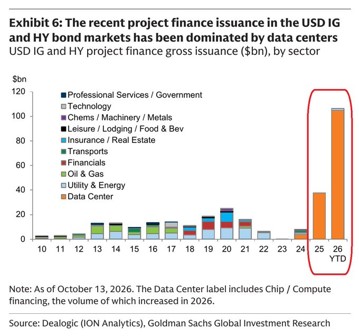
On top of that, global project finance issuance is expected to reach $300 billion next year, which does not include an estimated $420 billion in direct bond issuance by major cloud companies.
This growth, paired with rising rates, has put pressure on U.S. credit markets. Recently, AI-related high-yield spreads and data center spreads hit their highest levels ever. Data center bonds have fallen well below par in recent weeks. This has led to a surge in demand for protection against corporate bond defaults. Weekly trading volume of CDS linked to large AI companies hit a record $9.5 billion last week, quadruple the value in July.
This recent route in AI bond markets comes as Gartner released a study that stated AI data centers will need to generate $8.5 trillion by the end of 2030 to cover capital and financing costs and generate healthy returns. The weakest-rated securities and companies are seeing the biggest spreads as investors begin to look under the hood when it comes to reckless AI spending.
We think these AI bonds are selling off for a variety of reasons, which include the actual demand becoming weaker for these products with mass issuance, execution risk, investors questioning the return on investment on these AI computing power and data center projects and rising interest rates. Investors are essentially not willing to stomach some of this risk, especially in the highest-risk names, as upside in debt is limited compared to the unlimited upside of equity.
At the end of the day, many investors already have concentration risk on the equity side in terms of the AI industry. That is also now happening with some fixed income allocation, which is amplifying the concentration issue.
We expect spreads to remain elevated in the space in the short to midterm. In the long run, as AI revenue is realized and grows, these spreads will likely tighten.
What we are watching next week
After another busy week of earnings, our eyes next week will be hyper-focused on Wednesday as the Bank of Canada and Federal Reserve announce their latest monetary policy decisions. We do not expect the FED to raise rates next week just days before the U.S. midterm election. As of this writing, the CME FED Watch Tool places an 85% probability that the FED will hold rates in place. We will be looking more at the verbiage and tone of Kevin Warsh’s press conference for indications of the Fed’s future moves.
On Thursday, the latest U.S. GDP figures will be released, which will give the FED some guidance on the state of the overall U.S. economy. The forecasted quarterly growth rate is 3.1%, which would be an increase from last quarter’s growth rate of 2.2%.
Beyond economic data, next week is yet another big week for earnings, with the likes of Visa, Alphabet, Microsoft, Amazon, Shell, and Caterpillar reporting. The earnings of many miners are also due to be reported, which will give us updates on the state of their cash flow, margins, and balance sheets after a volatile year for metal prices.
MacNicol & Associates Asset Management
October 23rd, 2026
Download in PDF format: