
Share This Post Today!


Harrison Point Lighthouse, Saint Lucy, Barbados

This lighthouse is one of four lighthouses on the island and was built in 1925. The lighthouse stands at a height of 85 feet tall and was eventually deactivated in 2007. In 2011 the lighthouse was relit with a continuous red light.
Ragged Point Lighthouse, Saint Phillip, Barbados

This lighthouse which was built in 1875 at the easternmost point of Barbados. The lighthouse stands at 29.7 meters tall and has a focal height of 65 meters tall. The lighthouse was deactivated by the government around 2010.
*Feel free to send us your photos of Lighthouses to be featured in our weekly market observations.
A few charts as we begin earnings season
Third-quarter earnings season kicked off this week, with many Wall Street firms, including Johnson & Johnson, UnitedHealth Group, semiconductor producers, and others, reporting. Many other firms will report across the next few weeks. This week we wanted to share a few key statistics about earnings sentiment, analyst expectations, and industry factors driving this quarter’s earnings season.
According to data providers, sell-side analysts are expecting a strong earnings season and are painting a positive picture before many companies’ report. According to FactSet data, the S&P 500’s estimated third-quarter earnings growth is 29.6%, its third straight quarter of 25%+ earnings growth. Historically, the S&P 500’s quarterly earnings growth has been 12.6%. According to many, the third-quarter earnings growth is expected to come in even higher given the typical earnings growth of corporate America and analyst expectations. These estimates have removed some uncertainty across financial markets when it comes to earnings during a period of dwindling investor sentiment, extreme market concentration, trade wars, and geopolitical tension.
According to FactSet, 72 companies in the S&P 500 have issued third-quarter earnings forecasts ahead of Wall Street analyst expectations, the 10-year average has been 40. A senior analyst at FactSet stated to Barron’s that this quarter marks the highest number of S&P 500 companies issuing positive quarterly earnings guidance since the company began tracking this metric in 2006. On the downside, only 44 companies have released negative guidance – well below the 10-year average of 57 companies.
When you dive deeper into the companies releasing positive EPS guidance, 61% of the 72 companies are classified as technology companies, with software and semiconductor companies leading the way. The semiconductor industry continues to lead the market and is being driven by rapid earnings growth, with FactSet’s expected EPS growth of 130% this quarter. When you compare the technology sector’s proportion of the S&P 500’s positive corporate earnings announcements (61%) to the technology sector’s weight in the S&P 500 (38-39%), concentration and a lack of breadth jump off the page, which many investors continue to ignore.
Beyond technology, the other sector driving upward revisions is energy, with energy prices remaining elevated due to geopolitical conflicts. Wall Street expects energy companies in the S&P 500 to jump 121% year-over-year. In June, expectations sat in the 65% range as a peace deal seemed more likely.
The two sectors with earnings expected to grow the most YoY and that are seeing positive guidance revisions are also driving net profit margin growth. According to FactSet, net profit margins are expected to jump by 2% YoY, with energy and information technology companies leading the way.
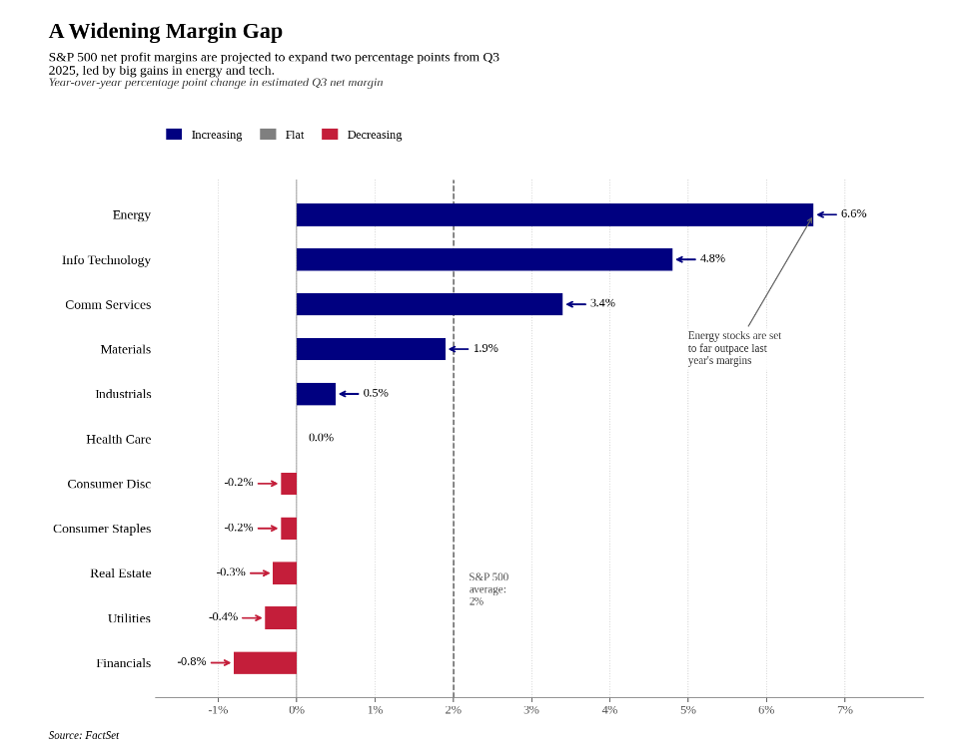
Many of the components of the S&P 500 are passing along rising costs, which are not impacting net profit margins (yet). According to FactSet, the S&P 500’s net profit margin is forecasted to hit its highest quarterly level since 2009.
Looking beyond this quarter’s strong forecasted earnings growth, analysts expect growth to slow over the next year but remain well above 10-year averages. FactSet estimates forecast YoY growth for earnings to be 28%, 18.2%, and 15.4% over the next three quarters (after Q3 2026).
After an extremely strong period of earnings growth, the growth now looks to be peaking, which could impact stock prices as investors are forced to re-rate companies. However, despite the slowing growth, earnings per share are expected to continue to grow above historical average rates, which could continue to fuel investor optimism. We would warn investors to look deeper into the numbers and not focus on headline numbers, as right now growth is being driven by a small number of companies which continue to drive growth and stock market performance.
Perhaps this concentration and lack of breadth will continue to lead markets higher for a few more quarters or even years due to the strength of these companies and the expansion of artificial intelligence. The issue is that this brings a new risk to the market: concentration and the elevated dependence the market has on one sector. What will happen if some of the revenue commitments that these AI companies make do not come through or margins contract due to competition and efficiencies? The market will pull back heavily, as it did in the early 00s when it was highly dependent on new-age Internet companies.
According to Goldman Sachs, the S&P 500 remains roughly 1% from all-time highs; despite that strength, the median constituent is down 16% from its all-time high, with only 21% of constituents trading above their 50-day moving averages (Raymond James), the lowest level since April 2025.
Goldman Sachs Investment Research also published a report that shows S&P 500 breadth is at its lowest level since the dot-com bubble at the start of October.
These statistics reflect the weak breadth in markets. The headline number, which is being carried by one trade, is hiding a deteriorating market that has real weakness. We think many investors, especially retail investors, are ignoring this fact as they continue to blindly pile into technology and ride the index higher. This comes at a time when there have been massive outflows from fixed income funds. Diversifying across asset classes seems to be as important as ever in today’s markets, which are flashing warning signals across the board in our eyes.
Now over to Wall Street’s earnings
As we stated above, the first big earnings of this earnings season came on Tuesday after Thanksgiving in Canada and Columbus Day in the U.S. Amongst the firms reporting on Tuesday came four of the largest financial institutions in the world, including Citigroup, Goldman Sachs, JPMorgan Chase, and Wells Fargo. These banks put up mixed results, with JPMorgan Chase, the U.S.’s biggest bank by assets, posting a rare miss and Goldman Sachs posting extremely strong numbers (revenue and EPS) which blew past estimates from Wall Street analysts. Wells Fargo and Citigroup both marginally beat Wall Street with adjusted earnings-per-share estimates over the last quarter. Despite Goldman and JPMorgan reporting opposite numbers when it came to beating or missing street expectations, both stocks remained relatively flat on Tuesday while Citi shares lagged by more than 5% and Wells Fargo by 3,1%.
Goldman Sachs’ strong earnings were led by strong equities trading, while JPMorgan Chase investment banking and trading revenues came in at the lower end of the bank’s estimates. Analysts stated that JPMorgan’s past success has created high benchmarks for growth which, as we can see in uncertain times, are difficult to clear. The firm saw revenue and earnings growth YoY but missed quarterly estimates from Wall Street analysts. Reuters also stated that JPMorgan has modest exposure to AI space relative to the entire wholesale market, which is another reason for earnings slightly missing expectations and shares lagging behind the S&P 500 this year.
JPMorgan shares have increased by 11.1% over the last year (as of October 12th) versus a 19.1% increase for the S&P 500. Recent spikes in Treasury yields have pushed JPMorgan and many other financial stocks lower over the last six to eight weeks.
The overall sentiment from the banks paints an upbeat outlook as management teams expressed confidence that the AI investment boom will continue. David Solomon, CEO of Goldman Sachs, stated that we are in a “technology super cycle,” while the CFO of JPMorgan Chase stated that the push for AI ventures remains in effect and people are still looking for ways to access the market. Solomon pointed to AI as a reason banking and markets revenue will remain strong, stating that “we are in a top quartile market” when referencing current market conditions. The bullishness on AI and company spending on AI benefits these bulge bracket banks through additional advisory fees, trading, and other forms of revenue.
One clear bright spot amongst these earnings reports was clear consumer resilience despite rising interest rates. JP Morgan, Wells Fargo, and Citibank all reported rising spending on credit cards and improved consumer credit losses YoY.
On Wednesday, we got the second set of earnings releases from Wall Street as BlackRock, Bank of America, Morgan Stanley, and State Street all reported. In pre-market trading, the only company whose shares moved higher initially was BlackRock, with losses being led by State Street.
On to the earnings…….
State Street shares slid heavily after missing revenue forecasts slightly and reporting heavy cash outflows. The firm beat adjusted earnings per share expectations and reported a 15% increase in total assets under custody and administration YoY.
Bank of America shares slid by more than 7% after missing third-quarter revenue estimates and a sharp profit decline after being hit with a $1.2 billion regulatory penalty. The regulatory penalty assessed by the Treasury was due to billions of suspicious transactions that the firm failed to report. Company wide revenue rose by more than 3% YoY but came in over half a billion dollars below street expectations. Fixed income trading revenue declined by 17%, something most of Wall Street saw this quarter with rising yields. The firm’s equity trading and investment banking divisions reported revenue that was in line with expectations. A Wells Fargo analyst stated that the firm’s results were “worst in class,” referencing the firm’s capital markets results in a research note. The CFO stated that the regulatory penalty was a one-time charge. Due to this penalty, the firm reported a return on tangible common equity of 12.6%; without the penalty, it would have been 14.9%. The bank stated that it would target a ROTCE between 16 and 18% over the next five years.
Morgan Stanley reported strong results driven by its investment banking and wealth segments but shares still slumped slightly on Wednesday. Morgan Stanley reported $232 billion in new net assets to its wealth division, a substantial increase from the third quarter last year. Morgan Stanley continues to operate the largest wealth management business in the U.S. in terms of assets. The firm’s top line grew by 12% while its earnings jumped by 6.5%. Analysts pointed to these results as good but not great, which reflected the slight decline in its share price on Wednesday.
BlackRock reported the strongest results amongst Wall Street firms earlier this week, driven by strong investor inflows. The firm beat adjusted EPS expectations by 12.6%, and revenue jumped 19% YoY. The results reflect the asset manager benefiting from its scale and its dive into private markets. The firm’s management also stated the strong results were driven by strength in its iShares ETFs and active trading strategies. Larry Fink stated the firm saw inflows for every client type, region, and strategy during the quarter.
We will say the stock price movement on Wednesday after the firms above reported was impacted by the inflation report, which we will cover later in this publication. At a high level, the CPI report weighed on the entire market.
Overall, the third quarter reflected stronger profits for Wall Street, driven by strength in wealth management and investment banking. Most of the firms are forecasting continued growth in their net interest margins, but valuations, yields, and macro risk remain major head winds which could impact performance in the coming quarters.
Currently, we do not have any major U.S. bank exposure. However, we continue to look for entry points, especially with the premium the Canadian banks are trading at relative to their U.S. counterparts and compared to historical averages.
U.S. CPI comes in HOT
On Wednesday morning, the U.S. Bureau of Labor Statistics released its latest inflation report. The report sent stocks lower after an ugly report where the headline and core CPI rates increased in September. The headline CPI came in at 3.7% for September versus 3.4% in August; economists expected a print of 3.6%. The headline number was the third highest reading since mid-2023 as inflation reignites across the economy and shows signs of being a structural issue rather than cyclical. According to Charlie Bilelo, this is the 67th straight month that the CPI has been above 2% (the Federal Reserve’s target inflation rate).
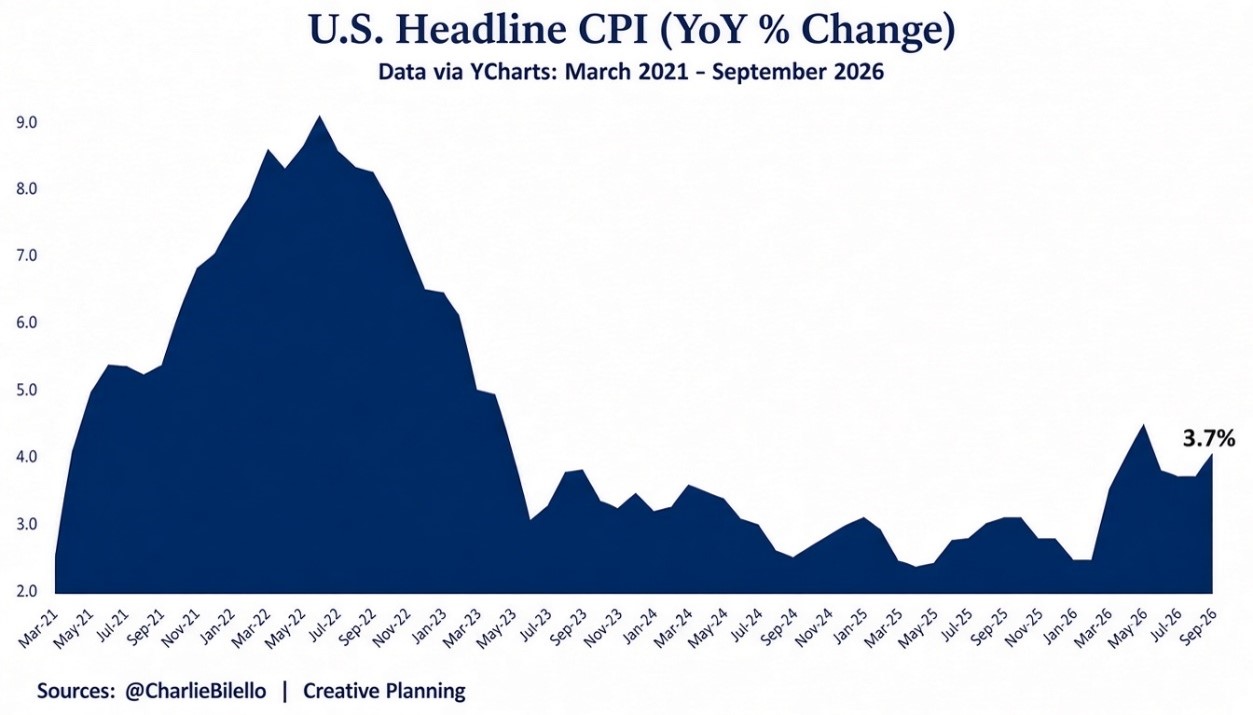
Image created with Grok AI
The headline inflation rate was driven by higher energy prices, with the continued conflict in Iran and the Strait of Hormuz remaining heavily disrupted. Gasoline prices rose 9.1% in September, but other non-energy items also saw price increases, including shelter, apparel, used cars, airfares, and hospital services. Although the CPI remains elevated, we believe consumers are facing even higher rates of inflation due to adjustments to the calculation of the CPI. U.S. import prices increased 7% as of the end of August, the highest level since August 2022.
We think the CPI could move even higher in the coming months as the strategic reserves that countries are releasing to the market slowly. The economy is already feeling the pressure of higher energy prices, and we will continue to see other products increase in price with energy prices remaining elevated.
The weaker core CPI print in August completely reversed in September and pushed the Bloomberg Spot U.S. Dollar Index to its highest level since November, with traders now pricing in three interest rate hikes in 2027. Traders now see a 43.7% probability that the FED will raise rates in two weeks compared to a 22% probability before the CPI report was released. Wednesday’s inflation report is the last report that the FED will analyze before its next monetary policy decision.
Bond yields moved higher after this CPI print as investors reposition their portfolios for a hawkish FED. Yields have risen substantially across the world in recent months to multi-decade highs. On Wednesday, the U.S. 10-year hit 5.2%, and the 30-year rose above 5.5%. This rise in rates has impacted consumers, businesses, investors, and even governments. Last week, our investment team wrote an article in The Globe & Mail where they discussed this phenomenon, so we will not dive any deeper but encourage our readers to read the article by clicking here: https://macnicolasset.com/spiralling-chaos-from-the-bond-market-will-shake-the-world-economy/
We have long been forecasting sticky inflation and an upward trend in yields as a result. It has been a reason we have mostly avoided long-term fixed income since 2009. Our new alternative debt fund will also mostly avoid this duration risk due to the potential for further interest rate increases. Today, we are not the only ones on the street who see higher rates; according to a Goldman Sachs survey, more than half of the respondents believe rates will push higher despite being at 20+ year highs. The same respondents are also mostly bullish on U.S. equities as well.
The latest CPI print will be on the mind of many consumers who head to the polls early next month for midterm elections. Consumers are feeling the impact of higher yields and rising inflation, which is reflected in the University of Michigan consumer confidence index, which fell for the third month in a row according to preliminary data. The index also fell more than economists had forecasted. Expect Democrats to hit voters hard with comments on the economy and the cost of living, which President Trump previously promised to solve. Republicans could get more bad news before the election in terms of the economy, as the FED’s interest rate decision will come just a week before the election. We do not expect any change to happen to interest rates before the election, and expect the first change to potentially occur at December’s meeting.
Before the CPI report, various FED officials had hinted at holding rates steady for now. That seems unlikely after the CPI report this week.
What we are watching next week
After a busy week of data releases from the Bureau of Labor Statistics, including the CPI report discussed above, and earnings releases, market participants remain hyper-focused on the next FED meeting, which comes in a week and a half. Before that, investors will be watching key earnings releases next, which include GE Aerospace, Netflix, Meta, Tesla, P&G, American Express, and ExxonMobil. These earnings will give us a better view of the state of the economy and the AI trade, which continues to drive the market. Beyond earnings, there are also some key economic releases we will be watching, which include the Canadian, British, and Japanese CPIs. Inflation has been a global issue that central banks will continue to need to combat.
MacNicol & Associates Asset Management
October 16th, 2026
Download in PDF format: