
Dyna Lighthouse, Oslo, Norway

This lighthouse is a reef lighthouse that was built in 1875. The lighthouse was eventually automated in 1956 and stands at 41 meters tall. In 1992 the lighthouse was renovated to host dinner parties for up to 20-40 guests.
New Point Loma Lighthouse, San Diego, California

This lighthouse sits at the southern tip of Point Loma. The original lighthouse was built in 1891 approximately 400 feet above water. The old lighthouse was often obscured by fog. The current lighthouse was built much closer to the water and has a 22 nautical mile range.
*Feel free to send us your photos of Lighthouses to be featured in our weekly market observations.
Couche-Tard makes a splash
Just a few weeks after Alimentation Couche Tard (ATD) reported its fiscal year fourth-quarter earnings, and they are already back in the news. The convenience-store operating giant announced an acquisition late Friday as Canadian investors began their long weekend. This acquisition would be the largest in the company’s long history and would completely contradict what management has been saying in recent quarters. Management has been stating that the firm was returning to its classic business model in which it relies on organic growth and small acquisitions, not large acquisitions, which we would classify this one as. Although we are surprised at this announcement, we are not disappointed. This deal is nothing like the 7/11 transaction that was proposed a few years ago. We think management has learned from that exercise and understand that shareholders want discipline and consistent growth, not a headline news story.
Let’s get into the deal. ATD announced that they had agreed to acquire a controlling stake in Zabka Group, Poland’s leading convenience store operator. As part of the announcement, ATD stated that they would be acquiring Zabka for a 9% premium at $32 per share (PLN). The transaction is unanimously supported by Zabka’s management, and ATD also stated that they had received support from shareholders accounting for 57% of Zabka’s shares outstanding (these shareholders already signed irrevocable agreements to tender their holdings). Those shareholders include management, CVC Capital Partners, and Partners Group. The number of shares ultimately acquired depends on acceptance under the tender. ATD needs 95% of voting shares to move towards a compulsory acquisition, which would delist shares in Poland. Until then, ATD expects Zabka to continue to operate under its own management team, brand, and operating structure. Management expects 60% ownership by the end of 2026 according to EPS estimates, and a step up to 100% ownership by the end of year 3. According to ATD, the offer implies a total equity value of $8.6 billion, or roughly 9x trailing twelve-month EBITDA.
The deal is expected to close by year-end and will be funded through committed debt facilities underwritten by JP Morgan, with Scotiabank and National Bank serving as joint bookrunners. The deal will require regulatory approvals at the EU level, and in Poland and Romania.
ATD management expects net leverage to reach 3.0x at closing and intends to return to its target range (2.0-2.5x) by the end of year 2. ATD’s current net leverage ratio sits below the average ratio for U.S. and international convenience store operators, as well as Canadian grocery store operators. This increase in leverage would bring them closer to the median average for ATD’s competitor set.
The deal will be dilutive to EPS in year one due to transaction costs, higher depreciation and amortization, and incremental financing. However, the expectation on the street and from management is that the transaction will become accretive in year two and beyond. ATD forecasts $250 million in run-rate synergies by the end of year three when ownership reaches 100%. Management also stated that they expect to generate a double-digit return on invested capital by the end of the year. ATD has historically been highly conservative with its underwriting of synergies when completing acquisitions, so do not be surprised if the number is higher by year 3.
Zabka has more than 13,000 locations across Poland and Romania, and processes more than 4.3 million transactions each day. Zabka also operates a digital ecosystem with 11.7 million users, an established loyalty program, advanced analytics capabilities, and a business that spans e-commerce, food service, and prepared meals. The firm has grown substantially in recent years as EBITDA has grown at a compound annual growth rate of around 20% from 2021 to 2025. The company reported $1.1 billion in adjusted EBITDA last year.
ATD is acquiring a growing firm at an attractive multiple. This acquisition will strengthen the firm’s position in Poland, which has been one of Europe’s strongest economies in recent years. ATD is trading in line with industry averages in terms of forward P/E ratios, and slightly above its historical average ratio. However, due to ATD’s forecasted growth, we believe this valuation is warranted and believe there is further upside in ATD moving forward, especially as the company realizes synergies and grow their presence in Poland and potentially across Europe. We like this acquisition for ATD and will be watching the company closely as more details are released and approval for the acquisition is complete.
Disclaimer: MacNicol & Associates Asset Management holds shares of Alimentation Couche-Tard (TSX: ATD) across various client accounts.
Retail turns over
According to Citadel Securities, July’s technology pullback reset the market. The pullback cleared out some excessive positioning and made retail net sellers as AI and semiconductor stocks were heavily sold. We think this derisking of retail portfolios is a sign, as retail has continuously “bought the dip” over the last few years, especially when it comes to technology and AI names.
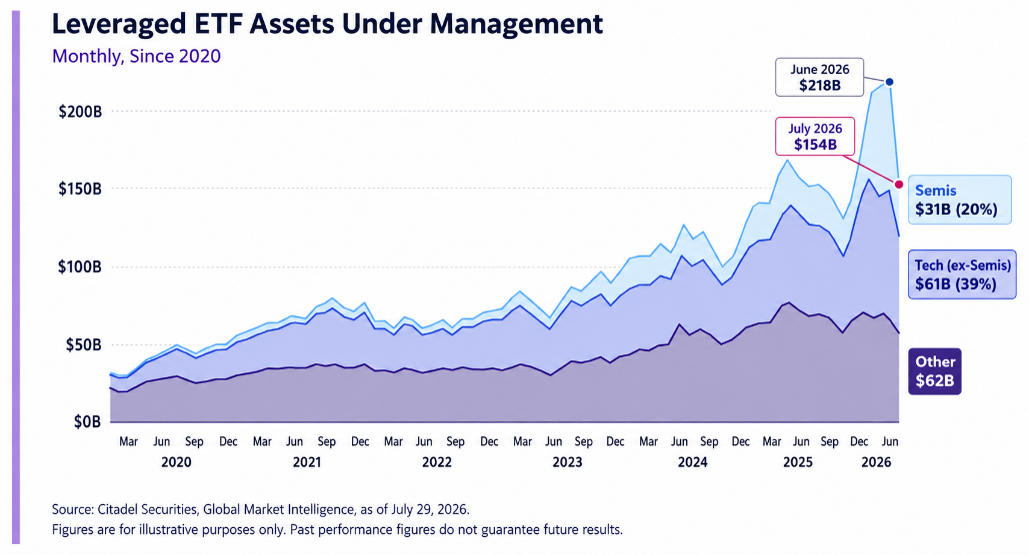
In July, leveraged ETF AUM fell by more than $60 billion. Most of this decline was driven by a decrease in AUM in leveraged semiconductor ETFs. Semiconductor stocks and ETFs had large pullbacks in July, which helped drive this massive AUM decline, as leveraged losses are multiplied on both the up and downside (something retail investors often forget or ignore).
The same Citadel research stated that this trend shows a structural shift in investor positioning, stating that the change reflects that investors can now focus more on fundamentals rather than pure positioning.
We think leveraged ETF trends reflect investor sentiment as well as anything in today’s market. July’s data shows that sentiment has changed and investors are now looking to derisk their portfolios, something we have been doing for quite some time.
This semiconductor pullback can best be described by a story that came out late last week where it was reported that a hedge fund was forced to sell a massive piece of their equity exposure at a discount in order to avoid a margin call.
SpaceX dives
On Wednesday morning, SpaceX shares reversed their early week gains. Shares moved down by more than 6% on Wednesday after the company reported earnings after Tuesday’s close. The firm beat street estimates for revenue, EBITDA, and numerous other metrics. The AI business even reported a surprise profit while the firm raised its 2027 revenue estimate to $100 billion from $72 billion just a few weeks ago. Elon Musk went on to say that sales could reach $1 trillion for the firm by 2029. Those brazen milestones will be driven by AI. Musk is not new to bold forecasts; he is known for big numbers and sometimes misses them. To put $1 trillion into perspective, Apple and Alphabet’s sales in 2026 are expected to near that mark. Despite these strong prints, shares moved lower partly due to the company’s AI spending.
The reason shares moved lower on Wednesday were due to AI spending, the IPO lockup period ending for many early investors, and the sharp run shares went on to start this week. During the second quarter, SpaceX spent $15.8 billion on AI, up from $7.7 billion in the previous quarter. The street expects this rate of AI spending to continue, with Wells Fargo’s analyst increasing its forecast for SpaceX’s capital expenditure to $263 billion next year from less than $100 billion.
On the IPO lockup front, 912 million shares are available to trade on Thursday, which is 140% of the stock SpaceX raised at its IPO. SpaceX’s IPO was thin in size relative to its valuation, which led to many investors competing for a small fraction of shares. That is changing beginning on Thursday. These shares unlocking could put further pressure on SpaceX, which is trading well below its IPO price and even more off its June highs. According to brokers and analysts, heavy selling is expected. Many pre-IPO investors and employees have reportedly shown interest in selling some of their stake in the company and rotating capital elsewhere. A large sale by an early Musk backer could send a strong signal to the market, which could lead to an overreaction.
We frankly do not blame investors who got in early that sell, as the volatility in SpaceX is real and concentration risk cannot be ignored.
Canadian construction icon
A Canadian construction and infrastructure development company has been on fire over the last year, and investors are taking notice. Aecon Group (ARE), the Toronto-based firm that delivers integrated solutions to both private and public sector clients, released its second quarter earnings late last week and reported very strong numbers. The firm beat street estimates for EPS and revenue by 13% and 12%, respectively. Shares pulled back over the last month by 7% after an extremely strong last year, when shares increased 152% (as of Wednesday). Here is a chart on FactSet that tracks Aecon shares relative to the TSX Industrials Index by S&P:
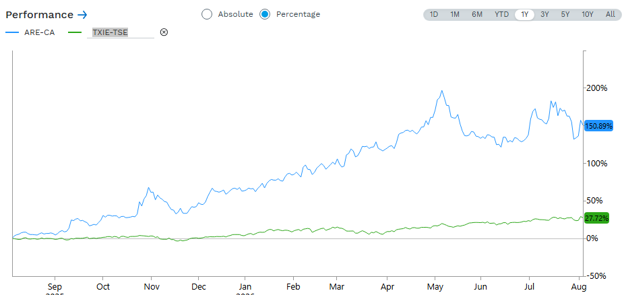
Source: FactSet
Despite macroeconomic uncertainty in Canada, ARE’s portfolio of projects reflects its competitive positioning across the utilities industry. Its work is being driven by rising power demand, nuclear refurbishments, and new builds across North America. The firm is also working on major transportation projects and new opportunities tied to defense and AI infrastructure.
In terms of the reported financials, ARE reported record quarterly revenue and an increase in adjusted EBITDA while maintaining its expectation of 10%+ revenue growth in 2026. The firm expects its revenue growth to continue in 2027, supported by strategic acquisitions, recurring utility programs, and the ramp-up of numerous multi-year nuclear projects. The increase in adjusted EBITDA was driven by construction margins. Revenue rose the most in utilities on higher volumes of electrical, gas, and telecommunications work in both Canada and the U.S.
The firm reported a diluted loss per share due to a $128 million fair-value adjustment related to its purchase of Oaktree Capital’s convertible preferred share investment in ARE’s utility segment. Excluding that adjustment, ARE reported an adjusted diluted EPS of $0.33 (higher than FactSet estimates).
The firm’s backlog came in at $10.5 billion, slightly lower than in the second quarter of 2025. Management stated that they have booked $2.7 billion in new contract awards through the first half of this year. Management went on to say that they have secured $4 billion of secured backlog executable over the next year. The firm also announced last month that it had secured a $1.7 billion contract to build a green light electricity center in Alberta, which will power an AI data center.
On the company’s earnings call, management pointed to nation building, energy transition, and grid modernization as key drivers that will accelerate demand. The firm is also looking to enhance risk management by shifting toward collaborative contract models to reduce fixed-price exposure.
In terms of valuation, ARE is slightly expensive relative to competitors, but we think that valuation is justified based on ARE’s forecasted revenue growth, competitive positioning, and quality project pipeline.
Disclaimer: MacNicol & Associates Asset Management holds shares of Aecon Group (ARE: TSX) across various client accounts.
The fundamentals in gold shine
Gold miners, alongside gold and other physical precious metals, have become strong hedges for investors and institutions against numerous risk factors. We believe this will continue moving forward as uncertainty and volatility continue to dominate the market.
2026 should, in theory, have been a strong year for gold and gold miners; however, after a record year in 2025, both have pulled back. We say 2026 should be a good year for gold and gold miners due to the macroeconomic picture, which has been plagued by elevated inflation, geopolitical tensions, and AI valuation/spending fears. The only negative trend in 2026 for gold has been a rallying U.S. Dollar.
Despite gold and gold miners’ recent weakness, we think both have upside beyond last year’s highs. We think the turnaround for gold miners could be sooner, as many miners have fixed operational costs and the price of gold has stabilized, creating technical support in the $4,000/ounze area over the last 3-5 weeks. Our technical analysis also points to a potential rally for gold after being consistently heavily oversold to start this year. A Senior Technical Analyst from Barron’s also stated that the VanEck Gold Mining ETF is on the verge of a massive breakout in an interview last week. Beyond the technicals and hedge aspect of gold miners, we really like the fundamental picture right now as profit margins are elevated, cash flows remain strong, valuations are attractive, and balance sheets have been cleaned up. These mining companies are also returning cash to shareholders through buybacks and dividends. The VanEck gold miners ETF now trade at nine times forward earnings; compared to its five-year average of 14x, gold miners are a screaming BUY to investors.
The mining industry is much more disciplined when it comes to capex despite rising margins. We think numerous firms across the industry have strong management teams that can guide their respective firms through the cycle without overspending or making mistakes. We also like many of these gold miners as they are mostly on the outside when it comes to the AI trade. The AI trade is impacting everything from software to financial services firms, and investors are piling in. Gold miners provide uncorrelated exposure to AI risk, as AI is not going to replace the demand for precious metals and how we mostly mine them.
Despite the pullback we have seen, we continue to like gold miners for the reasons listed above and are actively looking for new opportunities in this space.
Disclaimer: MacNicol & Associates Asset Management holds shares of publicly listed stocks, and ETFs that mine, refine, and process gold minerals.
What is happening next week:
As we head into next week, earnings season is slowing down and the final days of summer approach, when traditionally we see less activity in terms of trading, announcements, and even deal-making. Instead, we will be watching numerous economic factors, including the Canadian unemployment rate, which is due to be released Friday, and the consensus number is 6.5%. Next week we will be watching U.S. inflation data, which is due to be released by the Bureau of Labor Statistics on Wednesday. Inflation is expected to come in at 3.5% year-over-year, while core inflation is expected to come in at 2.6% over the same period. Inflation data will have a large impact on Federal Reserve policy moving forward, which will in turn significantly impact financial markets.
MacNicol & Associates Asset Management
August 7th, 2026
Download in PDF format: