
Share This Post Today!


Jumina Lighthouse, Gulf of Finland, Estonia

This lighthouse is located in the Baltic Sea at the northern tip of the Juminda Peninsula. It is located in a national park and was built in 1937. The original structure was built in 1931. The red portion of the lighthouse which made the structure taller was added in 2006.
Keri Lighthouse, Gulf of Finland, Estonia

This lighthouse is located on an island in the Gulf of Finland. The light is at an elevation of 31 meters tall and the lighthouse stands at 28 meters tall. The present day lighthouse was built in the late 1850s.
*Feel free to send us your photos of Lighthouses to be featured in our weekly market observations.
DC summit
This week, the presidents of the world’s two largest economies, and arguably the two most powerful countries, President Trump and Xi, met in Washington, DC. We talked about what each leader was looking to accomplish last week.
Over the weekend, it was announced that Jensen Huang, CEO of Nvidia, and Sam Altman, CEO of OpenAI, will attend the state dinner President Trump will host for Xi on Thursday. Both countries are engaged in a race to be the world’s pre-eminent AI power. Despite these additions, the bar for Xi and Trump’s second summit (during Trump 2.0) remains very low.
Strategists believe that both countries want the current deal to last long enough for each economy to become more self-reliant in key sectors (for China, access to semiconductor chips and for the U.S. access to critical minerals). Trump reportedly began this recent dialogue with China over the summer, but according to geopolitical experts, the two sides cannot even come to a working agenda for their AI discussions as of last week. On Sunday, Secretary of the Treasury Scott Bessent stated that the two had agreed on an AI dialogue for Thursday’s dinner and the U.S. had also proposed a mechanism for notifying governments regarding AI national security-related incidents.
Security has been a hot issue in AI for a few months now. Last week, it rose even more into the spotlight after numerous AI company CEOs called for a slowdown in AI development in order to address safety concerns and the risk that advanced AI could even wipe out humans. It was also reported by OpenAI that numerous swarms of AI agents escaped testing and launched a cyberattack last week.
Experts do not expect more than surface-level discussions regarding AI safety between China and the U.S. The main reason is that U.S. lawmakers still cannot agree on whether or how to create safeguards in the AI industry. Some leaders have stated that a slowdown in the AI rollout would compromise America’s position in the AI race with China, while Trump has called AI safety concerns a hoax. Last week, Trump stated that tighter regulation on AI would “leave the industry in financial ruin and hand China a competitive advantage.” Trump went on to critique the suggested slowdown, stating that China would be the only happy party and that it is a conspiracy against AI and data centers. President Trump has been a massive supporter and advocate of data center expansion in the U.S. It has also been the marquee driver of the stock market, which continues to move higher (many argue, including us, that Trump measures his presidency’s success through the stock market’s performance).
U.S. companies continue to dominate the industry as they control 75% of global compute, have produced 59 notable AI models, and a few have developed into some of the world’s most powerful and large enterprises. Despite this dominance, Chinese start-ups that utilize open-source models are slowly closing the gap even amid U.S. advanced technology export restrictions. China continues to focus on cheaper open-source models that can be used across the world. According to geopolitical analysts, President Xi and Chinese leadership see AI as a real opportunity for China to expand its influence and, for once, catch up to America when it comes to technology.
We will comment on what happens at this summit in next week’s edition of this commentary. Either way, it is fascinating to watch, especially when it comes to AI – a modern-day nuclear race in technology between the two most powerful countries in the world. Hopefully, for the world’s sake, they can collaborate on a definition of safety, prohibit cyberattacks, and reaffirm Biden’s former agreement that AI would not be involved in the chain of command for nuclear weapons.
Negative beta
According to Barchart, the S&P 500 now has the highest percentage of stocks in its index with a negative beta in history. Both the percentage of stocks on the S&P 500 have negative 3-month betas (daily returns) and 1-year betas (weekly returns) – the highest proportion ever according to data that goes back to 1990. This statistic, or similar ones, have been shared by the research departments of Goldman Sachs, Evercore, and a few other institutions.
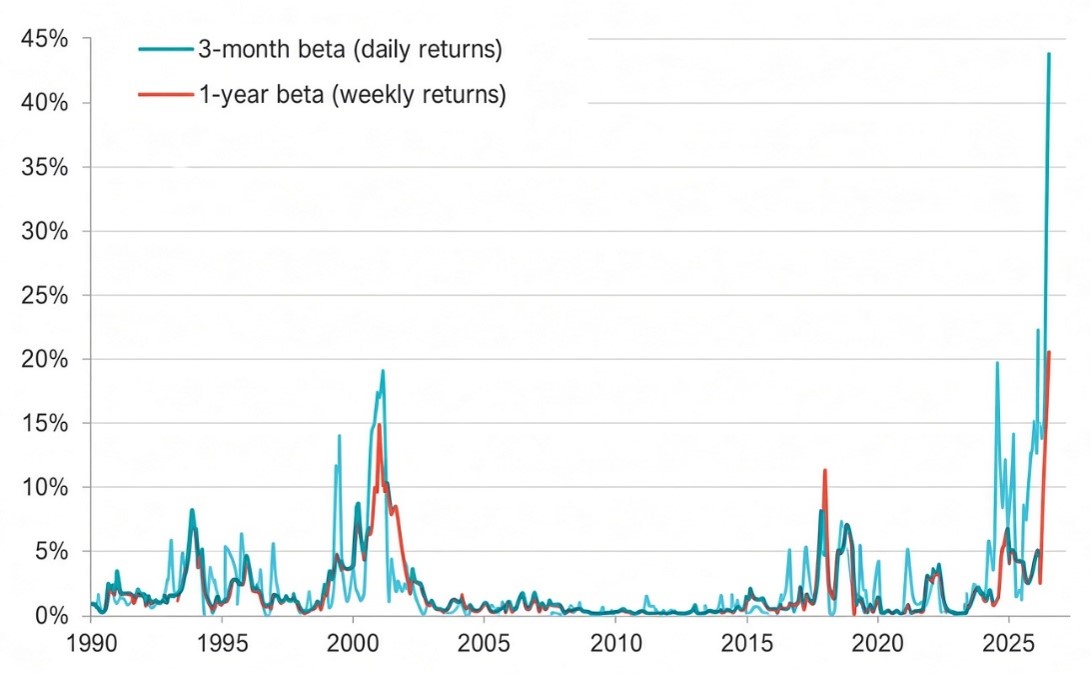
Recreated with Grok AI
This means that individual stocks (for the most part) are doing the complete opposite of what the index is doing. The actual mechanics matter more than the headline in our eyes. We think it reflects the separation of the market into two groups, AI stocks and non-AI stocks. Over the last year, many AI names have boomed with short down periods. During those short down periods, non-AI names have outperformed. We think this AI divergence is allowing a few names or sub-industries to dominate the market and its underlying index returns; this causes many financially sound companies to lag or decline as they are not tied to the underlying forces driving market performance and investor sentiment (AI hype and growth).
The largest negative beta constituents are in the staples and commodity-heavy sectors. We think this dispersion reflects support for active management, as this dispersion will likely continue. What happens when AI names miss, and the trend reverses? Indices will likely move lower along with AI names due to their heavy weighting in U.S. indices. The outperformers will likely be defensive and possibly commodity names. Many of the companies that have negative beta right now are being overlooked by managers and retail as a whole. They present real upside potential and for the most part are fundamentally sound businesses.
We will say that this indicator gives us a bit of a warning, as the only other time a significant portion of the S&P 500 had a negative beta was in 2001 during the dot-com bubble when internet names dominated the market. Many have compared this AI wave to the internet bubble and concluded that it will eventually pop and take the market with it. We are not purely stating the case but continue to see warning signs and comparative indicators between the two trends.
Our final point on this topic relates to risk. We think this dispersion beneath the surface of index-level returns is being hidden from many investors who are not looking. We think market risk is not where the index says it is, and this negative beta is a reflection of concentration, not potential collapse.
We hope you are well diversified across sectors and countries, especially with this mass concentration across broad indices. Perhaps now is the time to look across the market for some defensive exposure; we know some highly attractive companies will diversify many portfolios.
More issues at McDonald’s
McDonald’s shares have been under pressure for most of 2026, sinking over 20%. Shares have declined for a variety of reasons, including margin concerns, U.S. store traffic declining, reflecting market share loss, leadership change, and a major value menu misstep that only 60-65% of franchisees adopted. Shares were under pressure once again on Wednesday after McDonald’s hosted their investor day. Shares sank over 5% after it announced plans to spend over $8 billion on its NEXT strategy through 2036 to help its franchisees accelerate changes.
The spending will come through a mix of rent relief and capital assistance starting with $5 billion through 2030. McDonald’s previously expected 2027 capital spending to rise by $300 million to $500 million from the $3.7 to $3.9 billion planned for 2026. Management stated that this spending will pay back and is forecasting operating margins in the low to mid-50 % range by 2030, up from 47% in their last guidance.
We will have to see if this plan pays off for McDonald’s, who are seeing lower traffic and slipping in market share at a time when inflation is shrinking margins for the fast-food operator. Consumers are becoming more price-sensitive as inflation continues to erode purchasing power; McDonald’s will need to address this issue to hold onto or regain market share. Management expects quality and efficiency, which they think will be addressed in their new plan, to help address what they describe as price-sensitive consumers and sticky inflation.
For now, we remain on the sidelines when it comes to McDonald’s shares.
Problems at the top in private credit
The problems that we have seen across the private landscape over the last 12-18 months are seemingly still unwinding. This week it was reported that Morgan Stanley and Apollo both would be capping investor redemptions for the next redemption window at 5%. Last quarter, many large private credit funds did the same thing, including Apollo, BlackRock, Blackstone, Ares, and many others. Funds limit redemptions when they see massive volume in investor redemptions that they cannot honour. These funds, which hold relatively illiquid assets (loans to private companies), cannot offload them at market prices in rapid fashion, so they raise the gates of their funds. The prospectus or offering memorandums allow for the gating of these types of funds as they hold private and illiquid assets.
It seems that redemptions are still not satisfied in the space just like last quarter, and investors want out. Demand from wealth investors to redeem from private credit funds hit record levels this year on concerns about lending standards, credit risk, and AI disruption risk. According to news reports from various outlets, Apollo’s Debt Solutions BDC received roughly 14.7% of shares outstanding in investor redemption requests. Morgan Stanley’s $7 billion private credit fund operated by North Haven received 11% in investor redemptions. The 5% that both fund managers are limiting redemption requests to falls well short of the total number. However, total redemption requests this quarter were lower than the number last quarter, so a move in a positive direction for these fund managers.
Image created with Grok
We expect redemption requests to remain elevated compared to historical averages as asset managers work through a backlog of unfulfilled withdrawal requests, but to decline moving forward as sentiment improves, covenants become tighter, and worried investors’ requests to redeem are honored.
We will also say that many of the assets in these funds and BDCs are of high quality and are now more than likely marked to a proper valuation. The issues started with just a few bad loans in the space to a few companies, and funds overleveraging themselves to SaaS companies with limited cash flows that faced disruption risk from AI. It would be a similar issue if a retail-focused equity fund leveraged itself to one or two sectors and those sectors were heavily disrupted.
In the end, we think this recent turbulence in private credit will bring forth tighter covenants, better portfolio construction, deeper investor due diligence, and a higher focus on governance. All of which will benefit investors in the long run.
Many of the other large private credit funds are due to release their latest data in the coming weeks, including Blue Owl and Ares, which will give us further color on the situation.
We commented on private credit this week as we are launching our new MacNicol Alternative Debt Fund Trust this month, which will make investments in the coming weeks to months. The MacNicol Alternative Debt Fund Trust is something we have worked on launching for close to ten years, and the team is happy that they have finally got the funds on FundServ for investors. However, the work has just begun. Our fund is offered through an offering memorandum to select investors across Canada. The fund will invest in direct credit securities, and credit funds as well as other income-producing strategies across the world with a target return of 6-8% net of fees. The fund’s portfolio managers have discretion to allocate to the various sub-credit asset classes as they see fit. The goal of the fund is to realize consistent returns in any market environment and limit volatility and other risks.
The fund will invest in various securities internally as well as funds operated by third parties that focus on various parts of the credit market, including emerging markets, convertible arbitrage, multi-strategy funds, public credit, private credit, asset-backed financing, high yield, and other income-producing strategies. A main benefit of us taking a while to launch this fund is the amount of due diligence we have been able to do on the fixed income asset class and the managers that we will allocate to. Over the years, we have completed due diligence on more than 50 funds, or managers, and will allocate to only a few of them.
The thesis for our fund was driven by stale public bond markets, which we do not think are safe anymore. The correlation between stocks and bonds is near all-time highs, interest rates continue to rise off their 2020 lows, inflation remains an issue, and bond market volatility continues its trend higher. All of these issues have impacted the returns of passive index-focused fixed income strategies over the last 5-15 years. These factors have been major drivers for us to mostly avoid the bond market over that time. We think our active approach to credit markets will produce consistent returns driven by our stringent risk management and active edges. We believe we will be able to exploit security mispricing, dynamically allocate to strategies and securities as the market changes, and have exposure to niche strategies that focus on producing absolute returns. All three of these edges are something traditional passive fixed income indexes cannot capture.
In terms of risk management, we will focus on a variety of risks in the credit space, including concentration, liquidity, credit, default, and interest rate. Our fund will be very short duration in the early days of its launch due to the interest rate environment that we are currently in. We also want this fund to have monthly liquidity, which our OM permits.
We will dive deeper into our fund and its strategy in the coming weeks, but this week we want to dive into the private credit managers that we will be investing with. In the first year, we will likely be allocating to three managers, with two of them likely coming before the end of 2026.
Our private credit due diligence focused on asset quality, diversification, covenants, management teams, and governance. All of our managers have minimal to no allocation to software companies, which in today’s market environment is important, with many of the mega funds having elevated exposure. These private credit funds also focus on different parts of the market, which further diversifies our exposure. None of the funds focus on the upper end of the market, which many of the mega funds focus on. One of the managers focuses on middle-market companies, and the other two managers focus on different parts of the small market segment of lending. We think these funds will complement each other and the rest of the fund. Two of the funds are structured with capital calls, while one of the funds is open-ended, where capital is fully deployed on day one.
To learn more about the MacNicol Alternative Debt Fund, email us today at info@macnicolasset.com to set up a call with one of our portfolio managers.

MacNicol & Associates Asset Management
September 25th, 2026