
Share This Post Today!


Point Fermin Light, San Pedro, Los Angeles

This lighthouse is located in a neighborhood in north Los Angeles. The lighthouse was originally constructed in 1874 with lumber from California redwoods. The lighthouse is 30 feet tall and is on the National Register of Historic Places.
Point Sur Lighthouse, Point Sur State Historic Park, California

This lighthouse is located near San Jose at the peak of the 361-foot rock at the head of the point. The light station was established in 1889, and the lighthouse is located 270 feet above sea level.
*Feel free to send us your photos of Lighthouses to be featured in our weekly market observations.
Oil climbs again
On Tuesday morning, the prices of both Brent crude and West Texas Intermediate climbed to multi-month highs. Prices rose after Iran warned on Labor Day Monday that it would continue targeting U.S. energy interests in the Gulf if the U.S. launched new attacks against them this week. On Monday, The Financial Times reported that Saudi Aramco oil facilities were hit by fresh attacks. Analysts have been raising their oil price targets in recent days as the Iran conflict drags on. According to UBS, only 7 million barrels a day of oil is flowing through the Strait of Hormuz compared to the prewar average, which was 20 million per day.
According to Bank of America’s energy analyst, the price of oil could reach $150 a barrel if the conflict turns into a broader conflict and damages energy infrastructure across the region. This scenario obviously considers a worst-case scenario.
Amid this recent escalation, Iran has aimed at Canada for supporting the U.S.’s actions in the Strait of Hormuz. Iran’s Foreign Ministry posted online that Canada was attempting to appease President Trump and is portraying the country as a part of the U.S. Ironically, this statement comes as Canada and the U.S. continue to spar in regard to tariffs and trade discussions. Canada’s new tariffs, which impact $20 billion worth of goods, take effect on Tuesday.
On Wednesday, oil prices (Brent crude) continued their ascent, as they breached $100 a barrel, pushing equity markets lower due to inflation fears from investors.
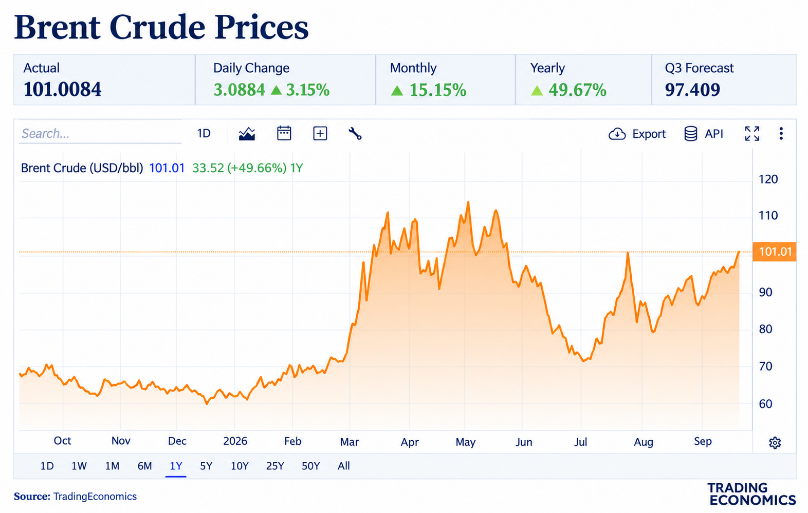
Image created with ChatGPT
Oil prices rose just a few days before the European Central Bank is expected to raise interest rates to combat inflation (the ECB met on Thursday before this commentary was written). This would be the Bank’s second-interest rate hike since the start of the war. Meanwhile, traders are now betting on a hike from the Federal Reserve, which is set to meet next week.
So far, markets have largely shrugged off higher energy prices, but that could change if global interest rates continue to move higher. Since the conflict began in Iran earlier this year, the S&P 500 has risen by more than 10%.
Amazon AI deal
On Tuesday morning, Amazon announced a deal with Qualcomm that could be worth over $60 billion. The chipmaker stated that it would work with Amazon across multiple generations of custom chips to support AWS’s artificial intelligence infrastructure. Beyond that, the companies also stated that they are actively working on optical networking.
Qualcomm shares rose on the news despite broader U.S. indices moving lower on Tuesday. This deal could be the trigger to reverse the downtrend that Qualcomm shares have been on over the last three months.
Qualcomm reportedly issued warrants for Amazon to acquire up to 25 million shares, which expire in 2036. The warrants represent a $4 billion investment. According to details of the deal, Amazon can only exercise those warrants if it purchases Qualcomm’s products and services. The shares unlock depends on various sales milestones reaching up to $60 billion in payments. Amazon has already acquired 3.75 million shares of Qualcomm on the initial commitment. Qualcomm also stated that it will deepen its use of Amazon’s AI services for its chip design.
Qualcomm was a laggard across its industry in terms of AI processors, but it has ramped up its efforts this year and has already struck deals with Meta Platforms and Microsoft.
Qualcomm’s AI push will look to diversify revenue away from smartphones, tablets, and gaming devices which their chips power. Qualcomm has made systems for Apple in the past, but Apple now is internally producing those. A significant portion of Qualcomm’s business has historically been tied to the phone producer. This deal with Amazon and other initiatives is a sign that Qualcomm has upside moving forward, and it’s not tied to Apple. We will have to see if Qualcomm is able to convert on these deals and produce revenue to offset its lost smartphone revenues.
Due to Apple’s rotation away from Qualcomm, its revenues have begun to slip and are forecasted to slip even further. Qualcomm previously said it expects handsets to make up just one-third of its revenue by fiscal 2029, down from 72% in fiscal 2025. The firm needs to desperately resolve that issue; this deal could be one of the catalysts that solve management’s problems. We are bringing this up this week not because we have exposure to Qualcomm but because it presents an intriguing potential opportunity down the road.
We will also say that this deal shows Qualcomm is far from competing with Nvidia. The deal is spread over a decade, and Qualcomm maintained its forecast for $15 billion in data center revenue in 2029. Nvidia reported six times the data center revenue last quarter alone. Qualcomm also had to give up equity in this deal, something Nvidia did not have to give up in its recent deal with Amazon, where the technology giant agreed to buy an additional 2 million Nvidia chips over the next two years. Qualcomm and Amazon also said their work would center on AI inference and output rather than Nvidia’s core strength of AI training. For now, it seems Nvidia will not be giving up the crown in the AI chip market despite numerous attempts from competitors across the world.
ARX deal closes
Last week, Shell announced that they had completed its acquisition of Arc Resources. The deal was first agreed on in April. We commented on the deal back in the spring as some of our investors had exposure to the Canadian energy producer. As part of the deal, Arc shareholders received cash and Shell stock.
The deal, which saw Shell purchase Arc equity for $13.9 billion (U.S. dollars), was the Canadian oilpatch’s largest deal in over a decade. Shareholders of Arc will receive $8.20 in cash and 0.40247 ordinary shares of Shell for each common share of Arc they held. Arc is one of the largest producers of oil and gas in the Montney formation, which provides rich natural gas reserves. Arc supplies safe, reliable, and low-cost energy through operations in Alberta and British Columbia.
We will monitor Shell’s performance after this acquisition but see it as accretive. According to the company, the acquisition will generate double-digit returns, bolster long-term cash flows, and be accretive to FCF as of 2027. For Shell, the company gains access to a long-duration, low-cost asset which complements the company’s existing footprint in Canada.
Shell is taking over Arc during the Iran conflict, where Middle East energy flows have been severely disrupted. We think this could be the first of many acquisitions in Canadian energy, as the deal shows Canada is a stable provider for global energy markets and is an increasingly safe environment in a modern world that is seeing more disruptions and conflicts.
We also think the deal passing shows the Canadian Liberals, led by Prime Minister Carney, are serious about expanding the Canadian energy sector and increasing the country’s export efforts beyond the U.S. Many analysts in the space have echoed these thoughts regarding Carney; however, many energy producers say Carney has not yet gone far enough in supporting policies that will allow Canadian energy to grow. Either way, it’s a step in the right direction and a change from the policies laid out by Canada’s last leader.
Disclaimer: MacNicol & Associates Asset Management previously held shares of Arc Resources across various client accounts and will receive shares of Shell PLC.
The China U.S. summit
As President Trump and President Xi are set to meet on September 24th in Washington, all eyes are on the two world’s largest economies. The meeting, which has yet to be confirmed by the Chinese, would mark Xi’s first trip to Washington in over a decade. The trip follows Trump’s trip last May and seeks to further stabilize the relationship and extend the truce struck last fall.
Many experts are keeping tabs on a few topics that the two sides will spar over that could cause speed bumps along the way. The bar remains low for this visit as it did last May, but analysts are looking for indications that will postpone an escalation in tariffs from the U.S. and restrict rare Earth metal exports in China. The current truce expires on November 10th, and an escalation in trade restrictions by both sides could cause serious disruptions in trade between the world’s two largest economies.
China will also likely push for more access to U.S. advanced technology, which they are currently barred from in negotiations. This could be a sticking point for the U.S. as the U.S. wants to remain in the driver’s seat when it comes to technology. We think China will also push against the recent U.S. moves to add more Chinese companies to a restriction list that bars sales to companies with ties to China’s military, as well as a sweeping ban on devices that contain inputs from Chinese companies. The U.S. did this for national security reasons, while China reportedly sees it as a blatant violation of their existing truce.
On the U.S. front, the Iran war has heightened the U.S.’s need for rare earths due to its munitions use. The U.S. will remain dependent on China for these metals for years to come despite massive investment announcements in the U.S., as these new projects will take time to come online. The U.S. will likely push China to relax its control on exports in the space, especially as China added ten new companies in July to an export restriction list.
Investors across the world are hoping that each side’s leverage will mean the status quo remains in place and the truce is extended. We think there will be more news on this topic in the coming weeks, but for now it remains on the back burner as other risk factors continue to dominate headlines and investor thoughts (Iran conflict, inflation, and rising global yields).
Wednesday’s announcement from Bessent
On Wednesday morning, Secretary Scott Bessent of the U.S. Treasury announced a $6 billion bond buyback program of long-dated U.S. government debt (10-to-20-year notes) in its Thursday operations. The actual purchases occurred in a 20-minute period that concluded at 2 pm ET on Thursday. This is an increase from the last stated guidance from the Treasury, which stated it would buy at least $4 billion at its August 19th press conference (the typical level is $2 billion). The move is an operation to keep bond markets functioning and will “aim to keep government bond markets liquid”. However, investors see it as an effort to keep a lid on yields which have hit highs not seen since 2008.
While estimates varied across the street on the size of the Treasury purchase, investors were still caught slightly off guard as yields rose after the announcement. The U.S. 10-year rose to its highest level since 2023, to as high as 4.85%. To put that number in perspective, the same note had a yield below 4% in March and a brief period last October. The market is sending a signal, and investors do not seem convinced that this is sustainable and that Bessent is in the driver’s seat.
The U.S. is not the only country seeing rising yields; yields are rising across Europe, where many believe, the European Central Bank will have to restart quantitative easing at a time when inflation is elevated.
The assumption from markets is that the $6 billion will be the same amount purchased in each of the six remaining buybacks through early November.
Higher yields, as we have mentioned earlier in the commentary and in recent editions of this publication, have impacted investor sentiment. Several factors are driving these yield increases, including soaring government debt, elevated inflation, and energy prices re-surging in recent weeks.
These accelerated buybacks have faced numerous critics, including Stanley Druckenmiller, who has stated that governments who attempt to defend prices always lose; the variable is how much money they spend before conceding.
Bessent is in an interesting spot; he knows the government cannot afford to service its debt at these levels and is trying anything he can do to suppress them. If the Treasury keeps upping their buybacks, they will have to issue shorter-term debt to pay for it and add to the debt pile. Either yields remain elevated, and the government, consumers, and investors pay higher rates on their debt, or the government continues to print its way out, and inflation remains elevated. Either way a major problem for the government, the FED, investors, and consumers as a whole.
What we are watching next week
Next week, we will be watching a few key items, including the U.S. CPI, which is due to be released on Friday morning right after this publication is distributed. Beyond U.S. inflation, Statistics Canada is due to release their latest inflation report on Monday. These two data pieces will give investors and Central Banks more guidance on the state of price stability amid the conflict in the Middle East. This is especially important for the U.S. Federal Reserve, which is set to meet next week and make its latest monetary policy decision next Wednesday at 2 pm EST.

Created with Grok
MacNicol & Associates Asset Management
September 11th, 2026