
Anacapa Island Light, Anacapa Island, California

This lighthouse station was originally constructed in 1912, and the current structure was built in 1932. The lighthouse sits on the Santa Barbara Channel entrance. The lighthouse sits at 55 feet tall.
Lime Point Light, San Francisco, California

This lighthouse sits on the narrowest part of the Golden Gate strait, very close to the Golden Gate north anchorage. The brick structure at this light station was built in 1883. In 1900 a lens lantern was hung on the south-east corner of the fog signal building.
*Feel free to send us your photos of Lighthouses to be featured in our weekly market observations.
Monday pullback
After two weeks of oil price increases due to increased tensions in Iran, prices pulled back on Monday morning after the U.S. announced it would be delaying attacks/military operations in Iran. The price of oil pulled back by more than 5% to below $90 a barrel after President Trump announced that he would be pausing any escalation attacks against Iran. According to reports on Friday, the U.S. was ready to launch two weeks of attacks against Iran. The operation was reportedly delayed so the U.S. could assess its shrinking stocks of Patriot and air-defense interceptors. The government did state that the U.S. could still order the attacks as the situation continues to evolve. On Tuesday, prices continued their decline to the low $80s.
The move brings new hope that a resolution is possible, and the Strait of Hormuz will reopen to vessel traffic. This week marks 150 days since the Strait of Hormuz was closed, through which more than one quarter of the world’s oil is shipped. Despite some progress in June in negotiations between the U.S. and Iran, vessel traffic remains well off seasonal averages, which has led to elevated oil prices and freight fees across the world:
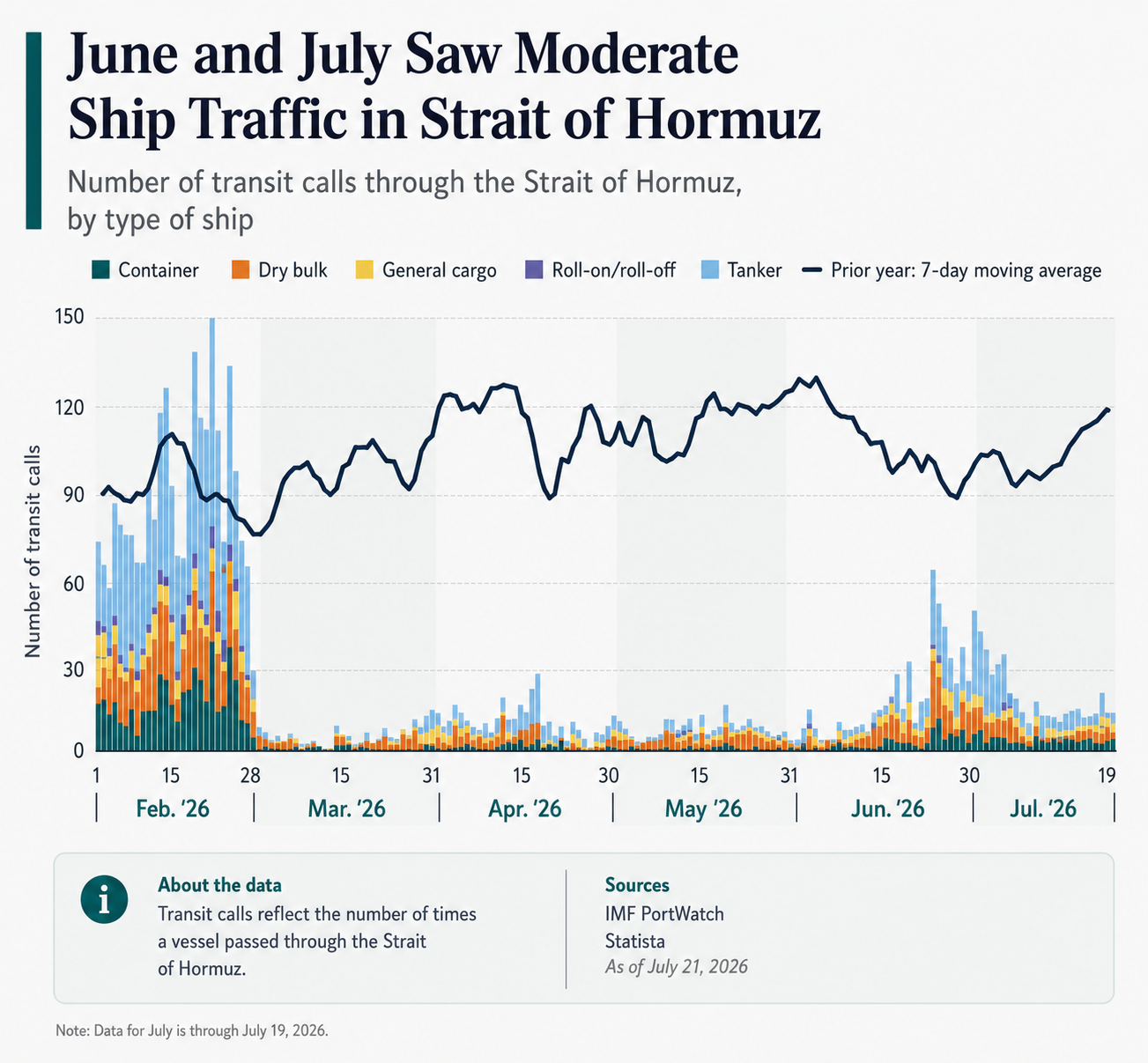
 We expect this situation to continue and do not foresee a long-term resolution right now. However, in the short term, we could see some positive news as the Trump administration races to alleviate inflationary pressures as we head closer to midterms in the U.S. in November. Not even a day later, Trump teased further attacks on Wednesday, sending equity indices lower and the price of oil up by more than 7%.
Beyond midterm elections, the Trump administration will be watching the Federal Reserve closely under their new leadership as they are forecasted to raise interest rates this fall in order to combat inflation. The FED met this past Wednesday to discuss monetary policy. Before the meeting, there was a 36% probability that the FED hiked; according to CME data, that percentage rose over the last week quite significantly. As expected, the FED held interest rates in place. However, the decision was contested as three members of the FED dissented. The three dissenting members voted for a quarter-point interest rate hike. Two of the dissenting members had recently voiced concerns publicly regarding broadening inflationary pressures.
The next FED meeting comes in mid-September. The FED Watch Tool by CME Group currently forecasts an 80% probability that interest rates will be higher after that meeting. A hawkish FED could severely hamper equity markets, which have been extremely resilient over the last year despite two major conflicts, broad-ranging tariffs, and protectionism by many countries. Beyond economic risks, markets remain extremely expensive in our eyes from a fundamental standpoint; if earnings start to turn over and slow down, there could be a serious pullback across global equity markets. We have already seen many of the technology names in AI turn over the last few weeks due to market volatility. What happens when the broader market does the same? We hope you are diversified and own quality names to combat a potential storm. We also hope you have downside protection like our investors. If you do not have downside protection right now, contact us through our email to chat with one of our portfolio managers and learn more about our protection methodology.
Capex causing hyperscaler spreads to widen
Over the last 18 to 24 months, hyperscalers like Microsoft, Alphabet, Meta Platforms, and Amazon have dove headfirst into AI. These companies have spent tens of billions on data centers, research, and AI infrastructure to attempt to get ahead. Originally, this spending was fueled by legacy cash flows from their strong existing businesses. That has since changed, as spending is outpacing organic cash flows, causing these mega firms to issue debt and equity for the first time in years. For years, these firms, along with many other technology firms, have been decreasing their share count through share repurchases; that has completely changed.
The debt issuance has been rapid; equity issuances have been historically large. This trend has worried investors as free cash flow is shrinking and is forecasted to run negative for some of these firms as they build their AI infrastructure. This has led to the credit ratings of these firms deteriorating slightly and their credit spreads widening. According to a Bloomberg article and Barclays data, long-dated debt from hyperscalers has crept into junk bond territory:
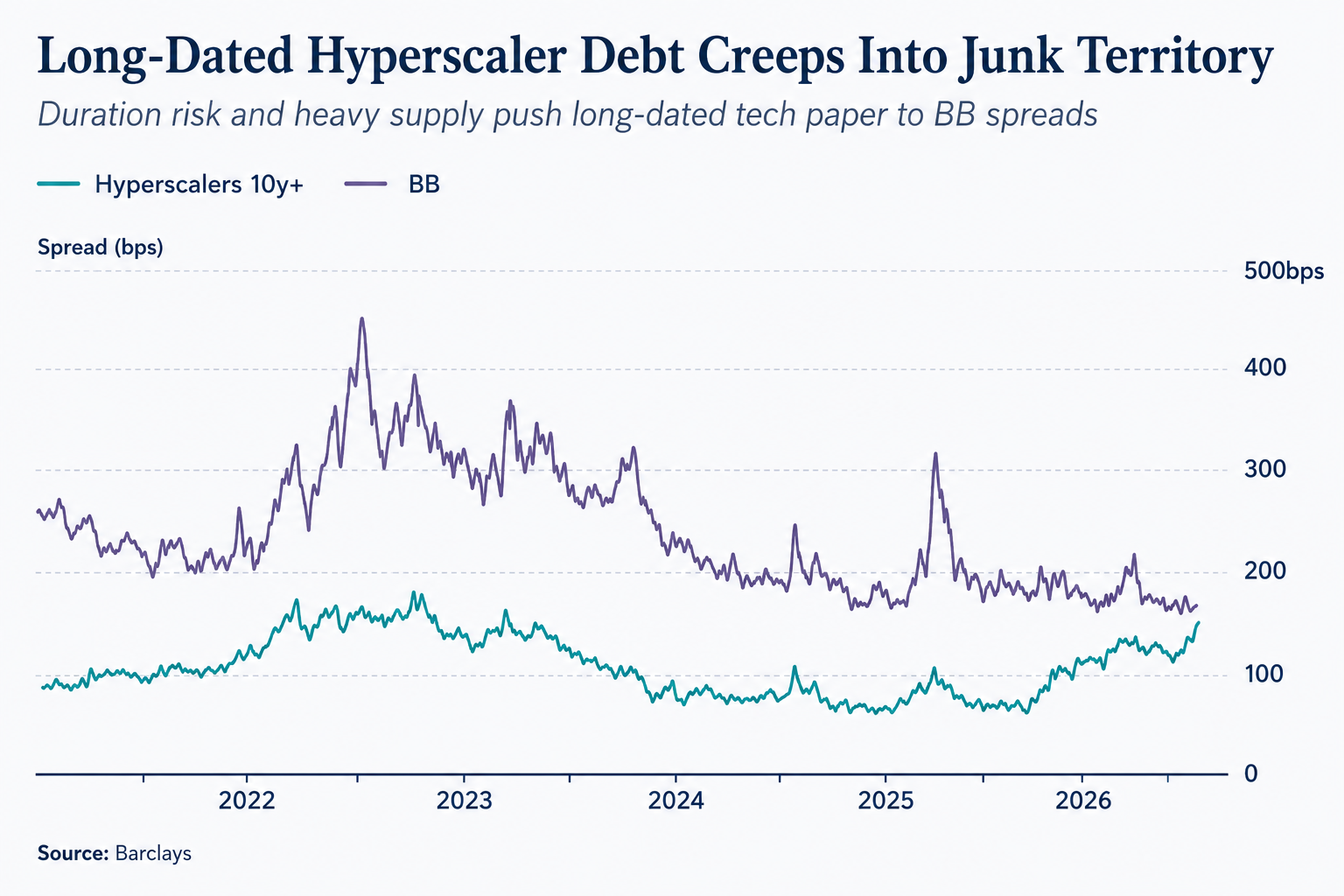
For those of you not familiar with credit spreads, a credit spread is the extra yield a corporate or risky bond pays over a safe government bond (in this case a U.S. Treasury with the same maturity). Most of the debt being issued by these hyperscalers is of long duration. This increases the execution risk for each firm as the entire industry could be misforecasting their spending.
Do not expect this trend to go away; last week Alphabet increased its capex forecast to $205 billion for this year, causing spreads on its bonds to widen and shares to sharply pull back. The other hyperscalers are due to report their earnings within the next few days and will give even more colour on the industry’s spending forecasts. According to Bloomberg, fixed income investors are already bracing for more debt issuance to fuel further AI spending. Barclays predicts that the companies known as hyperscalers will issue around $285 billion of investment-grade debt globally this year.
The other risk many investors are noting is concentration risk, this time in the credit markets. With this massive issuance by hyperscalers, fixed income indices are becoming heavily concentrated like equity markets. However, while that was driven by rising stock valuations, today’s fixed-income concentration stems from heavy borrowing to fund AI infrastructure.
Investors are already looking to hedge these risks as volume for credit default swaps on the hyperscalers has surged in recent months. We think this level of spending is unsustainable, and holders of this debt should be very careful with their exposure to these firms, as many have exposure to them via equity and debt. Although the same exact risks do not impact debt and equity securities, there are correlations, especially when you are looking at exposure in just a few companies across both asset classes.
Buyer beware.
Micron competitor goes public
On Monday, one of Micron’s largest competitors went public on the Shanghai Stock Exchange. The company, ChangXin Memory Technologies, is a chip manufacturer based in mainland China. The company, as of Monday’s close, was the most valuable company on mainland China, and only Tencent sat above it on the Hong Kong exchange. ChangXin shares surged by more than 460% on their first day of trading.
The stunning debut reflects the strength of the AI boom, specifically the memory chip boom. The AI boom has led to shortages of memory chips, something ChangXin Memory Technologies specializes in. This IPO was the second largest in China’s history (in terms of amount raised) and underscores China’s ambitions to build out a self-sustaining semiconductor industry. It also underscores the ferocious demand for AI exposure from investors across the world, including in China.
The overall industry for memory chips is led by Micron, Samsung, and SK Hynix. All three companies have seen massive surges in their stock prices this year driven by the strong demand for their chips and continued shortages.
The IPO comes as Apple has been lobbying U.S. officials to allow the company to use ChangXin’s memory chips for its products sold in China. Beyond ChangXin, another Chinese chip maker is expected to IPO later this year as the industry capitalizes on strong investor demand, increased sales, and order backlogs.
Analysts do not expect ChangXin’s IPO to initially impact Samsung, Micron, and SK Hynix. However, the IPO could initiate a wave of competitors looking to raise capital or IPO.
Speaking of Apple
On Monday, Apple dethroned Nvidia as the world’s most valuable company, lifting its market cap to almost $5 trillion. Apple has benefited from investors seeking safety in technology as its legacy business continues to be a cash cow. Apple is also spending much less on AI capex and technology than its competitors. Some investors believe technology companies are overspending on AI and efficiency down the line will improve significantly, negating much of the spending on memory and chip capacity. However, we, along with many Wall Street analysts, do not think it will hold this title for long, as iPhone price hikes could impact sales volumes, margins, and cash flows. Apple will likely raise the prices for its iPhones to offset rising memory-chip costs. This could make it tough for Apple to maintain earnings growth, especially for its new iPhone 18.
This is the first time since May 2025 that Apple was the world’s most valuable company. Investors have rotated capital into Apple and away from semiconductor names in recent weeks, according to KeyBanc analyst Brandon Nispel. However, he could see that changing as Apple’s issues are piling up, even with other issues plaguing the semiconductor industry, including circular financing (which we have talked about in depth over the last year), and competition from China.
Apple is not cheap by any means; after a nice run this year, it is trading above 35 times current fiscal year earnings. In our eyes, it will be tough for the company to maintain this valuation, especially in the current environment. Investors who are paying that premium are purely seeking safety in the wrong areas.
On the other hand, Nvidia’s pullback has made shares the cheapest they have been since 2015. Nvidia’s forward P/E ratio was 18x as of Monday’s close. Nvidia shares dropped by more than 5% on Monday after reports of talks with OpenAI over a $250 billion data-center project guarantee. The broader AI complex had a sharp pullback on Monday due to other news that a Chinese company had begun mass producing key chip-making machines.
Rotating capital from semiconductors to Apple does derisk a portfolio, but not in a substantial way in our opinion. In our opinion, investors should seek alternative asset classes, defensive sectors, and real assets in today’s environment in order to mitigate current economic and financial risk factors.
General Dynamics
A long-time MAAM favorite reported earnings on Wednesday and reported some very strong numbers. General Dynamics, a global aerospace and defense company, reported another strong quarter where sales and earnings beat street expectations. The company saw its sales grow across all four major business segments, led by a 15% increase in its business jet division. Earnings per share increased by 13% year over year and beat street expectations by more than 7%.
General Dynamics shares were flat on Wednesday after this earnings release but have been on fire in recent weeks, increasing 12.5% over the last month and 25% over the last year. More importantly, General Dynamics has managed to avoid much of the pain that defense stocks have been under over the last few months since the conflict began in Iran. General Dynamics shares are up 10% while Lockheed Martin and Northrop Grumman shares are down 12% and 24% respectively.
Beyond headline numbers, the company’s operating margin jumped to 10.4%, a 0.4% increase year-over-year. Orders also came in higher than sales once again this quarter, a good forecast for future revenue growth. The firm’s order backlog currently sits at a record level of $136.5 billion. The company’s CEO stated that the firm is positioned to support customer demand and will continue to make significant investments to increase output amid growing demand. The firm also guided fiscal year earnings per share higher than expected. The firm paid $429 million in dividends, invested $234 million in capex, and continued to reduce its debt during the quarter. During this quarter, the firm reduced its outstanding debt by $498 million. The firm’s cash generation also exceeded net earnings during the quarter.
The guidance provided by management reinforces robust demand across defense and aerospace. We think the firm’s segment outlook provides reasoning for shares trading near 52-week highs and continue to believe shares will trade higher as earnings and revenue grow. Our overall takeaway from this print is strong growth, expanding margins, and future revenue visibility.
Disclaimer: MacNicol & Associates Asset Management holds shares of General Dynamics (GD) across various client accounts.
What is happening next week:
Next week we will be watching earnings as numerous companies continue to report second quarter earnings. Overall, earnings have been rocky so far as hyperscalers continue to increase their AI spending. We will also be watching energy markets which remain uncertain and volatile as the conflict in Iran accelerates. In terms of monetary policy, the next date we will be watching closely is August 17th which is when the U.S. Bureau of Labor Statistics release their July Consumer Price data which could give us guidance on what the Federal Reserve will do at its September meeting.
MacNicol & Associates Asset Management
July 31st, 2026
Download in PDF format: