
San Felipe Light, San Felipe, Mexico

This active lighthouse is located in the northern region of Baja, Mexico on the coast of the Gulf of California. The 72-foot-tall lighthouse has an adjoining 1 story keeper’s house. It is located in a town known for fishing with a small resort area. The city’s population is approximately 20,000.
Punta Arena de la Ventana Light, La Paz, Mexico

This lighthouse was built in 2009 and stands at 92 feet tall. The lighthouse replaced an original lighthouse which had to be removed. The site is open to tourists.
*Feel free to send us your photos of Lighthouses to be featured in our weekly market observations.
SpaceX IPO
As SpaceX nears its IPO, more and more information continues to be released and reported. SpaceX shares are expected to debut on exchanges on Friday.
The company began its roadshow last week and is seeing strong demand. Investment bank CEOs like Jamie Dimon are directly pitching their wealthiest wealth management clients on the deal. Other brokerages are lowering the minimum account balance to participate in IPOs. For example, Fidelity slashed its SpaceX minimum investment for retail investors to just $2,000. That is a totally different clientele than typical IPO investors. Fidelity also reserved 30% of its SpaceX share allocation for SpaceX for retail; typically, institutions allocate 5 to 10% of shares. Reportedly, the higher allocation to retail is the norm across institutions for SpaceX’s IPO. Fidelity is also reportedly punishing investors who sell SpaceX shares in the first 15 days of trading, labelling them as “flipper” investors. The penalties Fidelity will place against “flippers” include being blocked from future IPOs.
It seems every institution is trying to drive this massive IPO to as many people as possible. We think that is a slight warning sign and perhaps a way for employees, venture capitalists, and other institutions to have a massive liquidity event. The $1.8 trillion valuation for SpaceX is massive when you compare it to its revenue, EBITDA, and future earnings. The company is looking to raise a whopping $75 billion in the IPO.
According to Reuters, banks are seeing $150 billion in demand for the IPO (two dollars in orders for each stock sold). In layman’s terms, the deal is two times oversubscribed. This sounds good in theory, but successful IPOs usually are two to five times oversubscribed. This strong demand can typically help support initial pops once a company’s shares begin trading publicly. We wrote this on Monday as investment bankers continue to build the book of orders for SpaceX shares, so demand could continue to grow.
Despite the general bullishness from investors for this IPO. Some are not as hot on the company. MorningStar pegs SpaceX’s valuation in the $780 billion range, and Barron’s stated that SpaceX shares would be a buy in the $90 range (the rumored IPO price is $135). Two larger groups with bearish views on SpaceX, something we share similar views with, at least initially.
The two things we know for certain are that we will be waiting on the sidelines to start this circus, and this circus (SpaceX IPOing) will likely increase market volatility for the foreseeable future.
As SpaceX is set to go public on the day this publication is published, we wanted to highlight a few early investors other than Elon Musk who are set to cash out on this valuation. According to reports, this IPO could create 1000s of new millionaires from stock options. Beyond employees, numerous large investors are set to benefit from SpaceX going public, including Alphabet. Alphabet invested $900 million in 2015 at a $12 billion valuation. Their investment is expected to be worth around $100 billion, depending on the IPO price. Alphabet also has a stake in Anthropic, which could be worth more than $130 billion at IPO. An investor a little closer to home for us that is set to benefit from this IPO is the Ontario Teachers’ Pension Plan, which expects an $11.6 billion windfall from a $300 million investment into SpaceX in 2019. The OTPP is Canada’s largest single-profession pension plan with $279.4 billion in net assets.
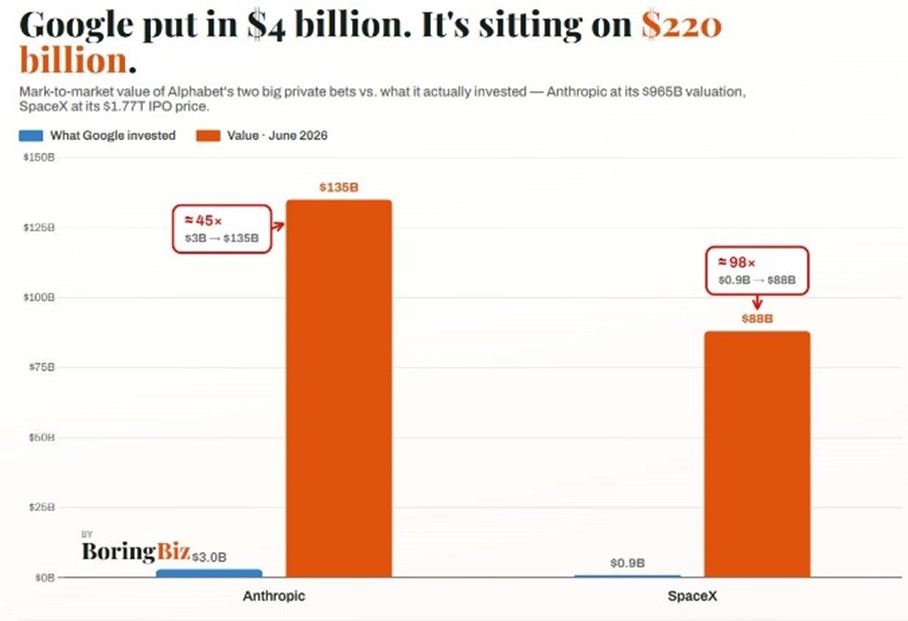
SpaceX’s other investors include Fidelity, Founders Fund (Peter Thiel), Sequoia Capital, Valor Equity Partners, Andreessen Horowitz, EchoStar, Saudi Arabia’s Public Investment Fund, and the Abu Dhabi Investment Authority. Many of SpaceX’s largest institutional investors include close peers and friends of Elon Musk. Elon Musk is rumored to own 42% of SpaceX equity and over 80% of the voting power due to the superior shares that he has held onto. This elevated voting power results in a lack of governance in our eyes when it comes to SpaceX and allows Elon Musk to mostly control his firm despite it being public.
In terms of comparisons, this year with IPOs, the average first-day move for IPOs in 2026 has been a nice 15%. A few blockbuster deals have fared even better with AI chip maker Cerebras, jumping 70% on its IPO date. However, most names have seen pullbacks after initial gains this year, including Cerebras, which has seen its shares slide by almost 25% since its initial pop. According to Jefferies analysts, larger IPOs see a larger initial pop, but that pop erodes over time. Since 2000, they said, IPOs with a market valuation above $10 billion enjoyed a 26.5% return on average from their opening price within their first week of trading. By the end of their first full year of trading, the returns fall to just 3.5%.
The other two pieces to look at when it comes to SpaceX are its recent performance in private markets and its underlying financials. SpaceX’s valuation has surged in recent months, marking a large amount of money already made by investors in SpaceX. Beyond the manic ride SpaceX shares have gone on in recent months, shares are outright expensive relative to its performance. The company trades at nearly 100x revenue. With those two facts paired with the early performance of IPOs over the years, we think there is more risk associated with SpaceX than reward. Don’t just believe us, this week Brian Hamilton of Barron’s called the valuation stratospheric and claimed SpaceX is asking you to “buy a myth”.
The last point that we wanted to touch on (until next week) on SpaceX is regarding the potential consolidation of Elon Musk’s empire. There have long been rumors that he wants to merge his companies. Numerous sell-side analysts have been reporting on it and believe that it is more likely once SpaceX goes public. There is now an intensifying view that a merger would greatly benefit Tesla. Although Musk runs both companies, a deal would have massive hurdles to pass through, including regulatory and shareholder approval.
With SpaceX’s IPO due this Friday, OpenAI filing IPO paperwork on Tuesday, and Anthropic filing initial IPO paperwork last week, it seems there is a rush to go public for the few massive private companies. These companies all operate in revolutionary industries that are looking to disrupt legacy sectors. All have raised substantial amounts of capital and are on the minds of investors. Despite this desperation to go public, a competitor of some of these firms is taking the patient route (it appears). Perplexity, the AI developer that is a major competitor of OpenAI and Anthropic, stated that it plans to go public in 2028 despite this recent rush to go public from its competitors.
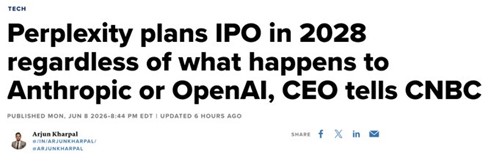
The company’s CEO stated that the SpaceX IPO could be a leading indicator and said AI spending is moving away from mindless spending toward cheaper models when they get the job done. According to a technology database, Perplexity ranks 5th amongst AI platforms in terms of monthly users. Perplexity is targeting $656 million in Annual Recuring Revenue (ARR) by the end of 2026, up from $200 million in late 2025. The company will reportedly continue to remain efficient and look for ways to cut costs while also scaling moving forward.
Perplexity’s product is based on models from various companies. Its AI, when prompted, will figure out the best model to use for the particular task, taking into account cost.
We enjoyed watching the interview with Perplexity’s CEO this week, where these reports came from. In an era of mass spending and a rush to go public, it is interesting to see one company do the opposite and have some spending discipline and patience.
China all in on AI
Early this week, it was reported by numerous sources that the Chinese government is preparing to spend around $295 billion over the next five years building data centers. The spending commitment fuels Beijing’s ambition to propel its domestic AI industry and surpass the U.S. in terms of technology. China Telecom will operate most of the data centers.
According to the reports, China will rely on local suppliers such as Huawei for at least 80% of technology, such as AI chips, which squeezes out the likes of Nvidia and AMD. Last month, Nvidia’s CEO stated that the company was conceding the Chinese market as the market is inaccessible and has disappeared for them and Western companies.
Currently, ByteDance, Alibaba, and Tencent have placed significant orders for Huawei chips.
This announcement confirms something we have known for quite some time: it is a technology race that China is all in on. They are racing against the U.S., who have spent heavily in the private and public sectors over the last 2 years.
Bank of America research
Bank of America’s research department warned investors to take profits this week as seven of the bank’s ten bear market indicators have been triggered in recent months.
Here is a graphic that highlights those signals:
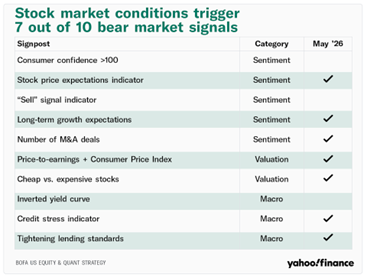
The indicators cover a wide range of marketing data, including consumer confidence, stock market expectations, credit levels, credit conditions, and valuations. The strategists highlighted the extreme outperformance of high P/E stocks relative to low P/E stocks as a sign of excessive speculation. Extreme price action and volatility may sometimes signal rising instability, which we have seen in recent months.
As of today, the spread and extremeness of the market between the top and bottom are at levels we have not seen since the Dot Com Bubble. Below is a Bank of America chart that tracks the top and bottom quintiles within the technology sector. We, along with many others, think the technology sector can tell us a lot about the markets today due to the weight it has across financial markets.
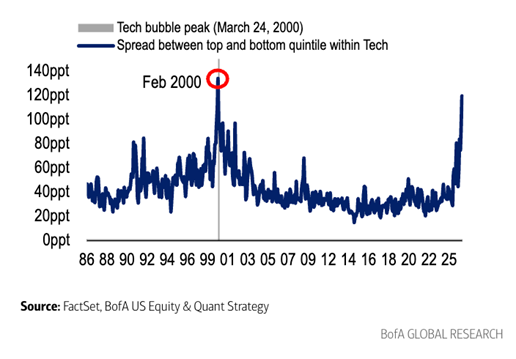
We will say, we are not warning of a doomsday scenario, we are simply showing research and developing conclusions based on said research. Remember, no matter the type of environment, some individual stocks do well, which is where active management comes to shine.
We think a combination of factors has increased the risk in equity markets, and many investors are ignoring them. We are not saying that you should fixate on them or rotate into cash; we are simply stating that investors should be aware of these risk factors and look past the headlines.
Inflation perks up
The Bureau of Labor Statistics reported its initial data for its May consumer price index on Wednesday morning. The report confirms what we have been predicting for a few months: inflation will perk up with this conflict in Iran, which is disrupting global energy flows.
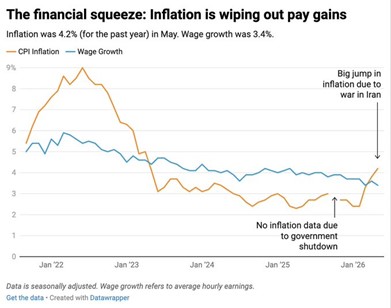
May’s CPI came in at 4.2% versus 3.8% in the month prior. May’s inflation rate came in at a 3-year high. May’s inflation gains were driven mostly by energy, with the energy index rising by 3.9% month over month, with gasoline costs rising even more by 7% in the month. Overall, the CPI’s energy components were up 23.5% YoY, with gasoline up 40.5% over the same period. The headline May number came in line with economists’ expectations. A few economists we talked to even stated they were encouraged by this report, as the effects of the conflict in Iran on prices have not spread.
Despite the large increase in the inflation rate in recent months, and fears that energy prices will cause other items to rise in price in the coming months. This has led select market participants to forecast potential rate hikes at the end of the year at the Federal Reserve. We are not in the business of forecasting what Central Banks will do, especially as a new Chairman takes over. We rely on expert analysis and data that help us position portfolios for any type of scenario. Right now, we think the FED will hold rates in place at its meeting next week. Next week’s FED meeting is the first meeting that Kevin Warsh will be the Chairman. We assume he will ease into the position, especially as the rate of inflation has risen. We will say the one silver lining from May’s CPI report for Warsh and the FED is core inflation, which came in at 0.2% in May, which was softer than expected. Core inflation strips volatile items in the CPI basket, like energy and food.
Warsh’s rhetoric during his nomination hearings softened compared to last year when he was almost campaigning for the FED Chairman role. During his “campaigning” period, he was pushing for rate cuts, which caught the ear of President Trump, who has been pushing for more rate cuts.
The one thing that we know for sure is that inflation is hurting middle- and lower-class consumers the most, especially as unaffordability was already a major issue. According to Heather Long of the Navy Federal, inflation is now erasing wage gains.
Looking forward, inflation could get worse as energy prices have been contained through various mechanisms, including demand destruction and strategic petroleum reserve releases. However, as we said last week, those releases are not sustainable and are expected to slow in the coming months. Last week, Bloomberg’s internal oil and gas analyst believed they would fall off a cliff in 12-13 weeks, which would cause price spikes at the end of the summer. Carlyle’s Jeff Currie raised an alarm this week over shrinking oil inventory and reserves, especially in the U.S.:
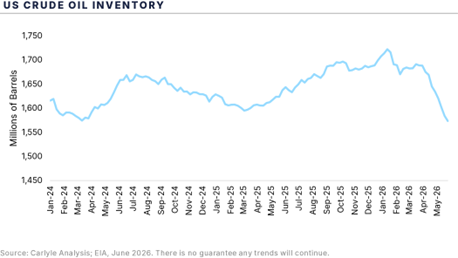
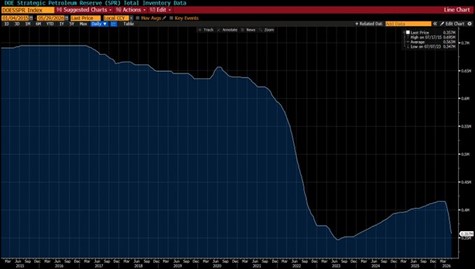
Last week, U.S. petroleum stocks fell by almost 14 million barrels. This is simply unsustainable. Once reserves are drained to extreme levels, prices will move higher unless the conflict ends, which at this point seems unlikely until after the midterm elections, as Iran reportedly wants to show the U.S. the impact of yet another war.
MacNicol & Associates Asset Management
June 12, 2026
Download in PDF format: