
Share This Post Today!


Carquinez Strait Light, Vallejo, California
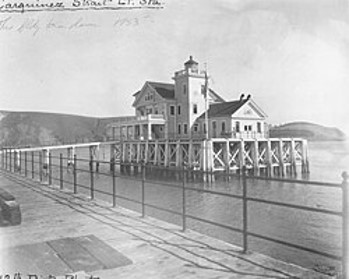
This lighthouse was first lit in 1910 and was eventually automated in 1963. For a brief period the lighthouse was deactivated in the early 1950s.
Mile Rocks Lighthouse, Lands End, San Francisco, California

This lighthouse is located 1 mile southwest of the Golden Gate Bridge. The lighthouse was completed in 1906 and replaced a nearby buoy. In 1966 the lighthouse was automated and the tower was removed and replaced by a helipad.
*Feel free to send us your photos of Lighthouses to be featured in our weekly market observations.
More AI confusion
This week, Nvidia announced its latest deal in partnership with Anthropic and Lambda. We’ve discussed the circularity of deals in the artificial intelligence industry in depth in past editions of this commentary. The circularity we refer to involves deals announced by semiconductor producers, AI platform companies, and hyperscalers. The deals loop capital, revenue, and demand internally rather than independent numbers and end user demand. The loop we are describing can be best represented by the graphic below:
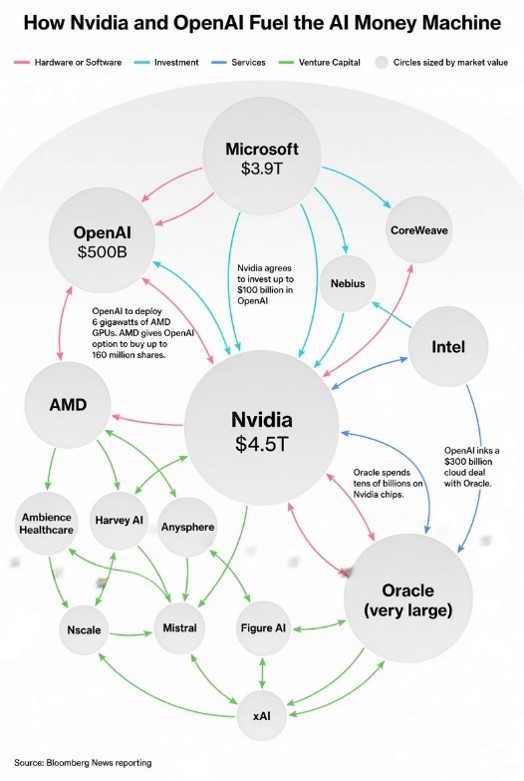
Image created by Grok Source: Bloomberg data
The image above was as of January, but the circularity has gotten even worse since.
We bring this up because of a new deal announced this week which is even more confusing than past deals. Anthropic, the developer of Claude, signed a cloud computing deal worth $35 billion with Lambda, a cloud provider. Anthropic counts Nvidia among its investors, and according to The Wall Street Journal, Nvidia is also a backer of Lambda. Investing in other external companies is not the confusing part of the deal. The confusing part is that Nvidia will hold the lease on the data center. What does this mean? An Nvidia-backed AI developer (Anthropic) is renting computing capacity from an Nvidia-backed cloud provider (Lambda), utilizing an Nvidia-leased data center that will be filled with Nvidia hardware. It’s truly an endless Nvidia loop.
On Nvidia’s last earnings call, management stated that they do not accept the term “circular financing” in describing these deals and its balance sheets, but it’s hard not to see it that way, especially with the firm being at the epicenter of almost every deal in the AI ecosystem.
Beyond Lambda and Anthropic, Nvidia has stakes in OpenAI, Intel, SpaceX, Corning, Marvell Technology, Lumentum, Coherent, CoreWeave, Nebius, Synopsys, Nokia, and MediaTek.
Nvidia investing in other companies is not a problem, as it is making good use of its strong cash flows and earnings and ensuring long-term stable revenue streams through demand for its hardware. The firm is also benefiting from the rising value of these stakes. The issue with many of these deals comes in the details, as many details are not disclosed and, in this deal, it’s not clear how Lambda will pay for its use of Nvidia’s leased data center or if it will revenue share in the Lambda-Anthropic deal. We think the worries regarding these deals could be solved with more transparency, but it does not look like we will get that today as Nvidia did not respond to requests for comment from news outlets regarding this deal on Tuesday.
Oil pops to $90
On Tuesday, crude oil prices hit $90 a barrel for the first time since late July on a few news pieces including reignited tensions between Iran and the U.S. The U.S. announced that they were carrying out more military strikes on Iranian targets in response to Iranian attacks on U.S. targets and service members on Tuesday afternoon. After the strike reports, President Trump stated that there would be further strikes from the U.S. if Tehran responds to initial strikes. It was also reported that two oil tankers in the Persian Gulf were hit by the Strait of Hormuz according to a Bloomberg report.
The renewed tensions brought forth worry from investors that the conflict could once again lead to the stoppage of oil flowing through the Strait of Hormuz.
Experts on the tension in the Middle East expect attacks to ramp up after a non-violent summer. Ameriprise Financials’ chief market strategist stated that this kinetic violence will disrupt supply chains and likely lead to elevated energy prices but will not lead to broader regional violence which will likely keep a lid on oil prices on the upside.
Over this past weekend the two sides exchanged attacks for the first time in a month.
We think oil prices will likely remain elevated moving forward as we have said a resolution seems unlikely in the short to medium term. There has been no major progress in terms of a deal despite the Strait opening up and a month without military strikes. We think that is why oil prices remained elevated as investors still saw the risk and potential for reigniting direct tensions between the two sides.
Market technicians also noted crude oil’s technical breakout on Tuesday afternoon in the $85-87 area, which could lead to further upside potential as technical traders pile into the trade. We think oil prices will likely remain elevated moving forward, as we have said a resolution seems unlikely in the short to medium term. There has been no major progress in terms of a deal despite the Strait opening up and a month without military strikes. We think that is why oil prices remained elevated, as investors still saw the risk and potential for reigniting direct tensions between the two sides.
Market technicians also noted crude oil’s technical breakout on Tuesday afternoon in the $85-87 area, which could lead to further upside potential as technical traders pile into the trade.
Tuesday’s surge in energy prices led to even higher yields across the world and a small pullback in equity markets. If energy prices remain above $90 a barrel, inflation will continue to remain elevated, which will make it hard for Central Banks, including the Federal Reserve, to hold rates in place or even cut them. They will likely have to raise rates, which would likely have rippling effects across global financial markets. Beyond investors, bankers, and consumers, the Trump Administration would likely be very aggravated by rate increases, especially from a FED leader that Trump appointed just a few months ago.
Earnings become old news
Stocks have slumped in recent sessions as earnings season slows down. Investors who have become highly reactionary are now paying attention to something other than corporate earnings. Although markets are only off all-time highs by a few percentage points, the momentum that has led the market has seemingly disappeared in recent weeks. We think it’s due to a variety of factors, including geopolitical tensions mentioned above, increases in global yields, and investors shifting focus from earnings season to macroeconomic data.
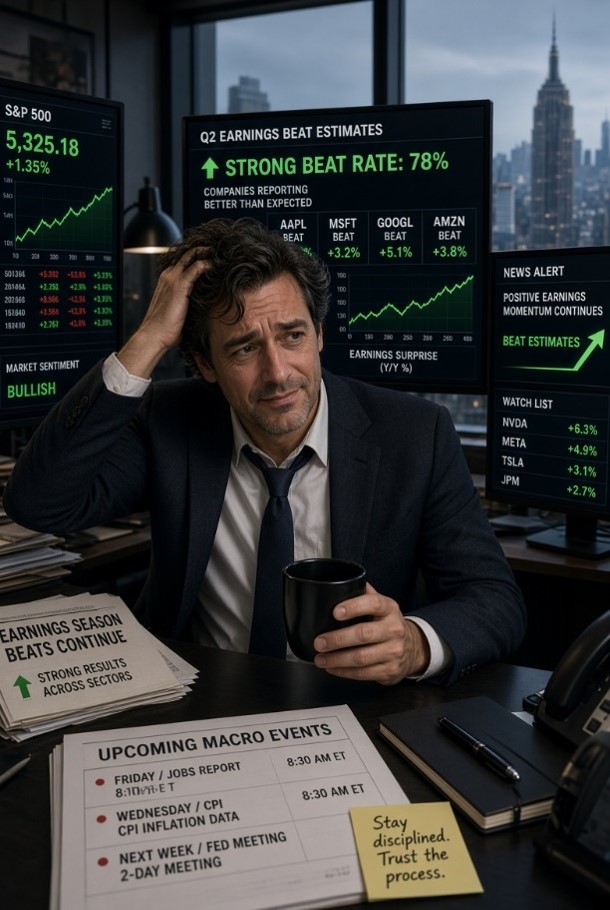
Image created with Grok
This could spell poorly for equity markets in September as it’s a busy month for economic data releases and a very slow month for corporate earnings reports. September is also traditionally the weakest month for stocks. According to Yahoo Finance, the S&P 500 has averaged -0.6% in September since inception, the only calendar month with a negative average return.
Over the last two months, firms have reported better-than-expected earnings, with S&P 500 companies pacing for earnings growth of 52%, more than double what analysts had expected at the end of June, according to FactSet data. Nearly 97% of the index has already reported; that could be an issue as investors become reactionary to macro data releases, and FED policy changes or statements rather than revenue beats, or AI spending targets.
In terms of macro data releases, starting on Friday, we will get August’s job report, August’s PPI and CPI, and have a FED meeting all within less than two weeks. According to Citadel’s head of equity and equity derivatives, the S&P 500’s implied move for the days of the four events just mentioned is larger than usual. According to his research, “the right tail around the next set of events is less obvious after a strong earnings season”. The right tail refers to the right-hand of a probability distribution; in this context it reflects high return periods.
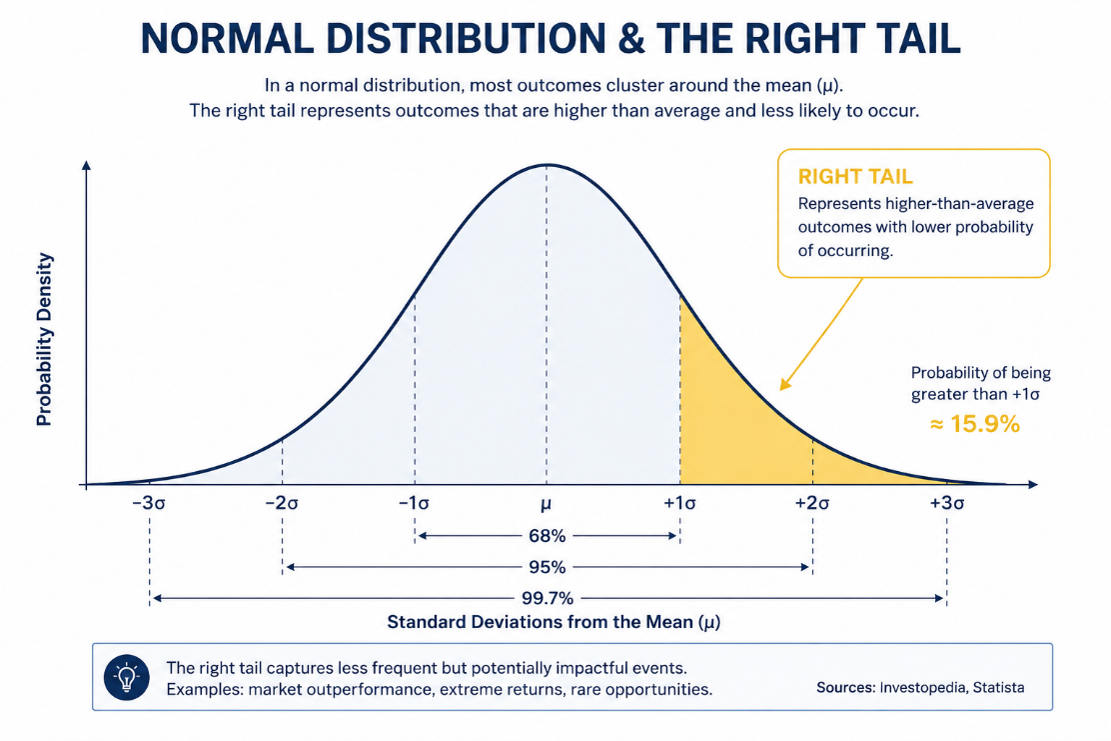
Image created with ChatGPT
Over the last week, the implied probability according to markets for a FED rate hike has increased from 40% to 66%, which has caused severe investor anxiety. We think markets will remain volatile and stagnant for some time as investors wait and see what Friday’s jobs report says and where inflation comes in for August. We know one thing for sure: investors as a whole will be hoping for a softer CPI print after the highest five-month average CPI print (YoY figures) since mid-2023.
As the jobs report will be released when this publication is already distributed, we will tell you what we will be looking for and reflect on what happened next week. Investors will be hoping for moderate job creation, stable unemployment, and no major wage growth, as that scenario would not force the FED’s hand and keep the “soft landing” narrative alive. We will have to wait and see how the jobs report looks before making any major calls.
We think September will be a challenging month for investors as yields could continue to rise and impact cyclical and high-growth stocks the most and the broader equity markets. We think in the short term, the defensive trade is the most attractive. Before you make a conclusion on our thoughts, we are not saying this is the end of the bull market; we think it could be a pause before the next major earnings period catches investor attention.
Checking in on Canada
A lot is going on for us Canadians: a trade war, inflation on the rise, rising unemployment compared to historical averages (especially for the youth), stagnant economic growth, and much more. We bring this up this week not to talk more about the trade war with the U.S. but due to Wednesday’s Bank of Canada policy decision.
The Bank of Canada held its benchmark interest rate in place for the seventh straight time at 2.25%, a move widely expected by economists. This decision comes amid a trade war and tensions in the Middle East, which have caused prices to increase. Governor Tiff Macklem stated that monetary policy cannot offset the effects of higher prices but is focused on ensuring that global developments do not impact price stability in Canada. Macklem was tight-lipped when asked if the central bank is more concerned about price increases or growth risks. He did, however, state that the Bank will continue to adjust monetary policy as needed.
In Canada, the rate of inflation in July came in over 1% ahead of the Bank of Canada’s target, and economic growth has remained soft for almost three years until last week’s second-quarter number, which came in higher than expected. Last week, it was reported that the Canadian economy grew at an annualized rate of 3.3%, the highest rate in three years. Statistics Canada also revised first-quarter data to reflect a growth rate of 0.3% after previously reporting a contraction of 0.1% for real GDP. Growth in the second quarter was mainly driven by higher exports, business capex, and household spending. Many economists do not expect the second quarter economic growth rate to continue.
Macklem’s comments focused on inflationary risks, which makes us believe the Bank of Canada has a bias toward rate hikes moving forward rather than rate cuts. However, numerous economists stated that the Bank of Canada will likely wait for improvement in unemployment or continued economic growth before deciding to hike. Macklem did state that due to global oil prices remaining elevated and showing few signs of easing, an interest rate hike is on the table for the Bank of Canada’s December decision.
We think it was smart for the Bank of Canada to hold rates in place as the Canadian economy remains weak. In our opinion, the downside potential of an early hike outweighs moderately higher inflation. Obviously, that could change if prices remain elevated and the CPI hits 5%+.
What we will be watching next week
As we head into the final long weekend of the summer, we will be watching numerous things. Beyond a few smaller holdings, it will be a slower earnings week for us. However, we will be watching yields, the bond market, and macroeconomic data releases. The bond market often leads equity markets, and right now the bond market seems worried. According to Bloomberg data, government bonds across the world are down 4.2% year-to-date, and government bonds with maturities of 10+ years are down 7.8%. However, these moves are relatively small when you compare them to 2022, meaning the bond sell off could get much worse. Further increases in yields could lead to a global bond selloff and more pain for fixed income and balanced investors. We think this event would have a grave impact on equities, which could catch many retail investors off guard. For the next few weeks, yields are what to watch very closely.
MacNicol & Associates Asset Management
September 4th, 2026
The Weekly Beacon September 4 2026 US