You spend your career solving complex problems for others. Your retirement shouldn’t be subject to market volatility. A defined benefit plan designed for the financial reality of successful professionals.
The standard 401(k) wasn’t built for a professional’s career trajectory.
Late entry into the workforce. High tax brackets. Exceptional liability exposure. Traditional market-linked retirement vehicles force you to shoulder sequence-of-returns risk precisely when you should be stepping back.
01
The Lost Decade
Starting earnest saving in your 30s instead of your 20s costs massive compound interest. A defined benefit structure can allow highly accelerated catch-up contributions.
02
Tax Inefficiency
Standard vehicles offer limited deduction caps. This structure can allow significantly larger pre-tax contributions for high earners.
03
The Contribution Ceiling
A standard 401(k) contribution limit represents only a fraction of many successful professionals’ earning capacity. A defined benefit plan can shelter multiples of that amount.
A defined benefit. Clearly defined.
Unlike a defined contribution plan, such as a 401(k), where you bear the investment risk, a defined benefit plan defines the intended payout. The actuarial and investment disciplines work together to support that benefit.
- Contributions can be deeply tax-deductible, often exceeding $100,000 annually depending on age and plan design.
- Portfolios are professionally managed in support of long-term pension obligations.
- At retirement, the plan is designed to provide a fixed monthly income for life, subject to the governing plan documents and applicable law.

Sample Projection
52
Age of Inception
~$165,000
Annual deduction
$18,500/mo
Income at age 65
Illustrative only. Actual contribution ranges and benefits are determined by an actuary based on participant data, plan design, funding status, IRS limits, and other assumptions.
CONTRIBUTION CAPACITY
Contribution capacity can change the outcome.
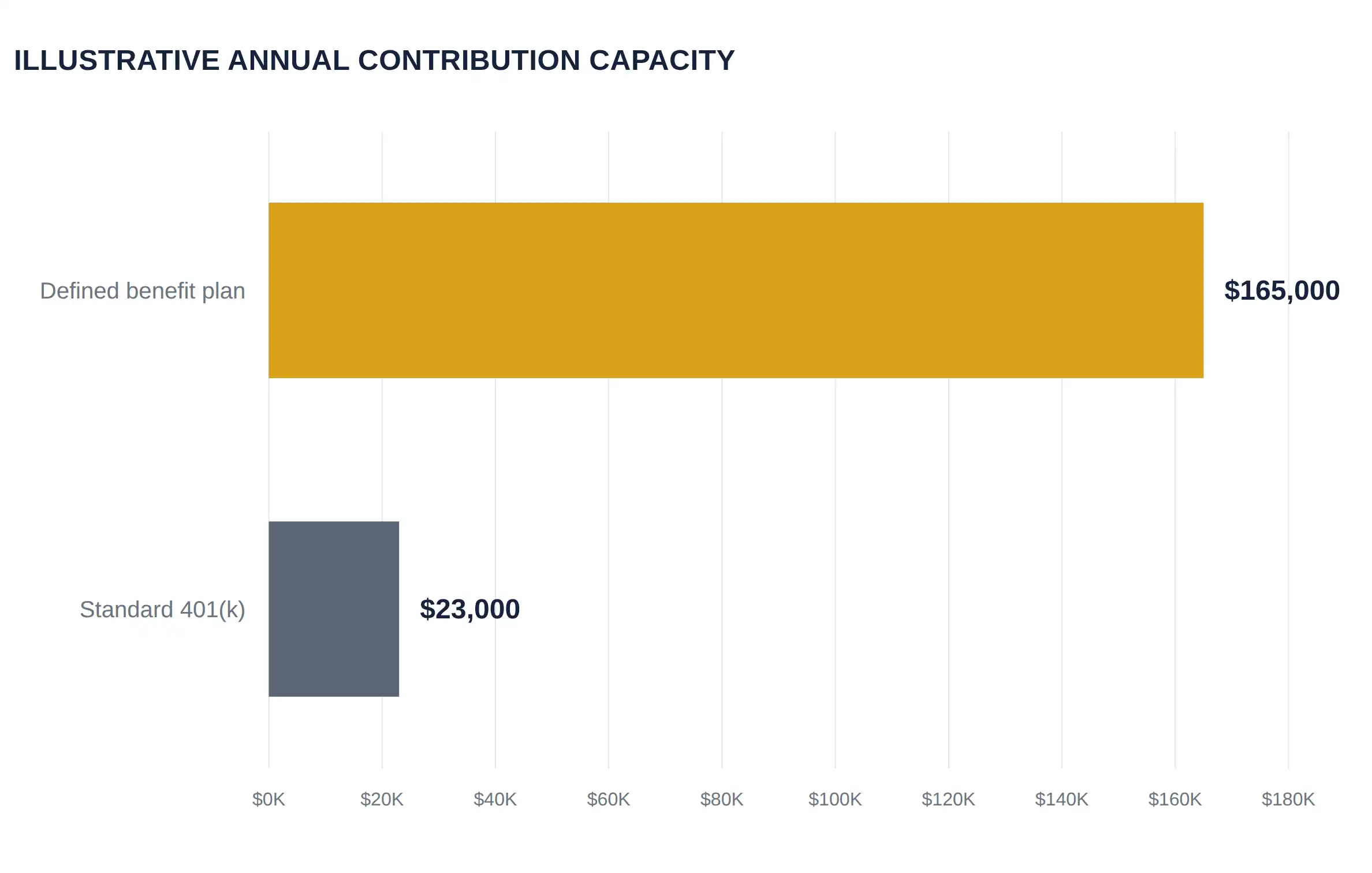
For a professional in peak earning years, the defining advantage is not merely investment selection. It is the amount that may be contributed on a tax-deductible basis.
ILLUSTRATIVE DIFFERENCE
A sample $165,000 defined benefit contribution is more than seven times a $23,000 standard 401(k) employee contribution limit.
This comparison is illustrative and not a statement of an individual’s permitted contribution. Current-year 401(k) limits and catch-up rules should be updated before publication.
ADVANTAGES
The compounding advantage, illustrated.
A professional beginning contributions at age 35. The defined benefit structure allows for substantially higher annual contributions—a gap that compounds dramatically over a 30-year horizon.
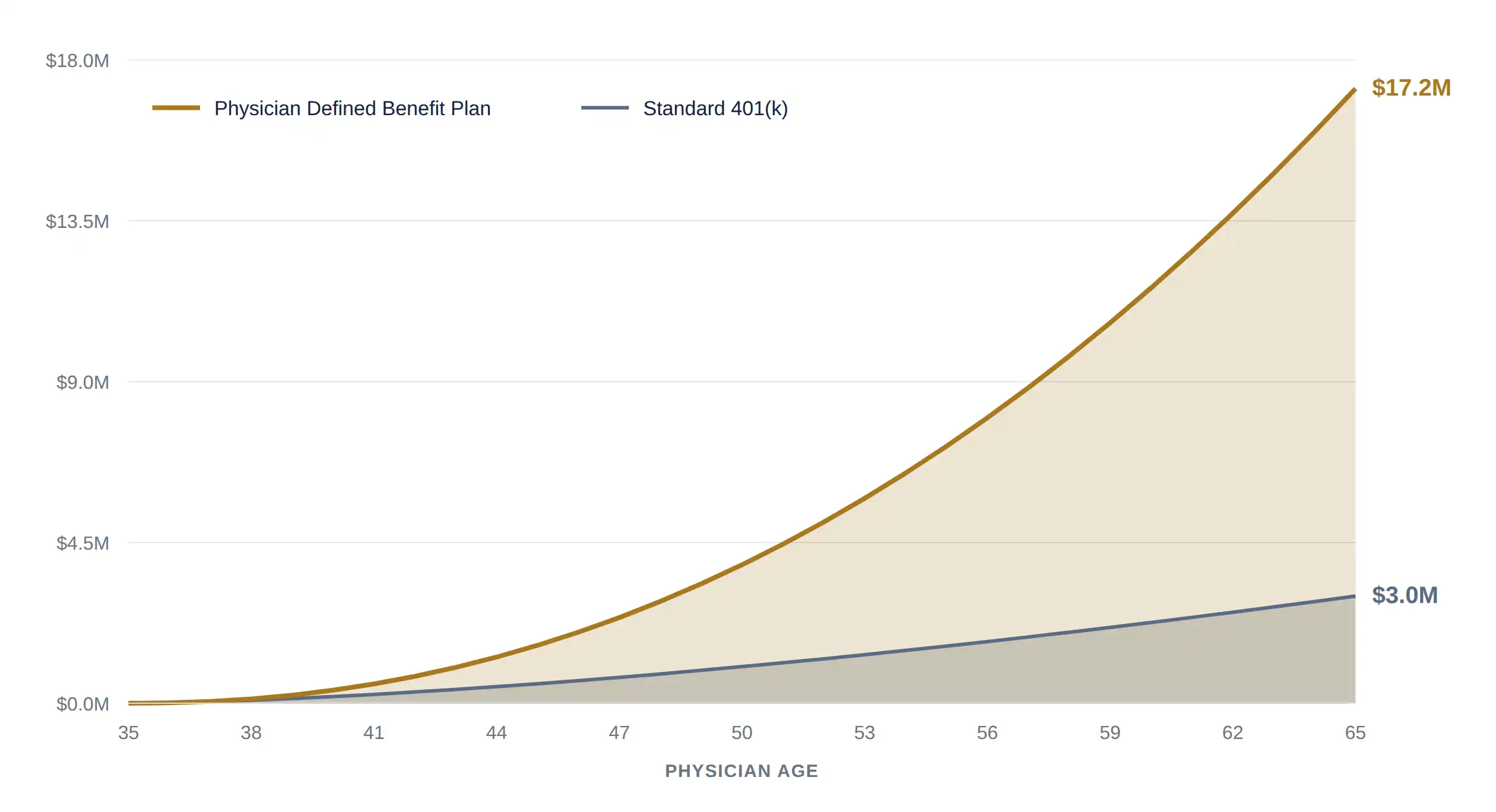
Illustrative projection. Defined benefit contributions assume age-based actuarial maximums of approximately $150,000–$200,000 annually. The 401(k) projection assumes $23,000 annually, increasing to $30,500 after age 50, with a 7% annualized return. For illustration only; not a guarantee of future results.
THE EXPERIENCE
Designed around your practice.
You make complex decisions all day. Your retirement vehicle shouldn’t require another layer of cognitive load.
- A private review of personal, practice, and retirement objectives.
- A custom actuarial projection showing a contribution range—not a one-size-fits-all promise.
- Plan design coordinated with existing 401(k), Profit Sharing, or Cash Balance arrangements.
- Professional implementation, administration, actuarial oversight, and investment management.
PARTNERSHIP
A coordinated partnership.
MacNicol & Associates Asset Management and INTEGRIS Pension Management Corp. bring complementary disciplines to the engagement: portfolio management aligned with long-term pension obligations, together with specialized plan design, actuarial coordination, administration, and ongoing support.

Investment management and advisory

Pension design and administration
FAQS
Frequently Asked Questions
Request a private analysis.
Speak with an advisor specializing in professional wealth and retirement planning to determine whether a defined benefit structure aligns with your practice, tax position, and retirement objectives.
- No-obligation analysis
- Custom actuarial projection
- Tax-mitigation review
Your information is kept strictly confidential and never shared with third parties.
For informational purposes only. Not intended as tax, legal, actuarial, or investment advice. Plan availability, contribution limits, deductions, funding requirements, and benefits depend on individual circumstances and applicable law. Consult qualified tax, legal, actuarial, and investment professionals before establishing or modifying a retirement plan.