
Share This Post Today!


Negril Lighthouse, Westmoreland, Jamaica
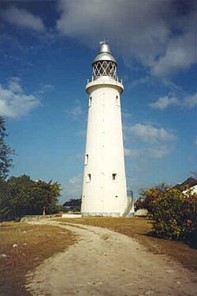
This lighthouse was built in 1894, 1.5 miles south south east of the westernmost tip of Jamaica by a French company. This lighthouse is one of the earliest concrete lighthouses and stands at 89 feet tall.
Morant Point Lighthouse, Saint Thomas, Jamaica

This lighthouse is on the easternmost tip of Jamaica and is the oldest lighthouse on the island. The lighthouse was constructed in 1841 by men from Africa. It is the first cast iron lighthouse built in the Western Hemisphere.
*Feel free to send us your photos of Lighthouses to be featured in our weekly market observations.
Anthropic’s prospectus released
This week, investors around the world finally got insight into the financials of an advanced AI model developer. Anthropic released its IPO prospectus on Monday (S-1 filing). The filing is 318 pages (we did not read the entire thing, AI will for us 😉), but the report is filled with a lot of information that can help investors in today’s market environment. The firm will eventually trade publicly on the Nasdaq under the ticker “ANT”.

Image created with Grok
The firm filed confidentially with the SEC in June, giving the SEC time to review its financials. The firm cannot begin its roadshow for fifteen days after making this filing.
The S-1 filing showed explosive growth, massive future spending obligations, and some thoughts on leadership’s beliefs about the superhuman power of AI. Anthropic’s revenue jumped from $1.2 billion in the first half of 2025 to $16.3 billion over the same period this year. However, growth has begun to slow, with revenue jumping 45% quarter-over-quarter to $16.8 billion in the period ending September 30th, down from a 100%+ increase the prior quarter. Another point of concern investors will focus on in this S-1 comes from customer concentration. Anthropic’s five largest customers account for 25% of the firm’s overall revenue, and many of those customers do not have long-term contracts in place.
On a positive note, Anthropic turned an operating profit in the second quarter of $974 million, driven by revenue and expense mismatches. However, Anthropic reported a net loss of $80.7 billion in the first half of 2026 while the firm’s operating loss was only $693 million. The firm also reported a $3.9 billion operating cash flow in the first half of this year. Anthropic was forced to report this massive net loss this year due to accounting regulations. These non-cash accounting charges were tied to the rising valuation of Anthropic convertible financing instruments. No actual cash left the company to create these losses, and that number should not be used to analyze Anthropic’s profitability trajectory.
Despite Anthropic’s future revenue growth trajectory, and ability to turn a profit already, there is a massive elephant in the room that many investors are worried about. That elephant in the room amounts to $800 billion and is the firm’s spending commitments over the next ten years. The firm already has committed $630 billion to data center capacity and chip leases over the next ten years, and it could potentially be on the hook for an additional $170 billion in commitments if milestones are met over the same period. Anthropic’s largest expense remains compute and infrastructure (computing power, cloud services, and data center capacity), which cash flows will continue to fund. Investors also expect a large raise from this IPO, where proceeds will be used to assist Anthropic with its spending commitments. A huge winner after this week is Broadcom, as Anthropic’s S-1 filing revealed how large a commitment ($161.2 billion) Anthropic has made to the firm.
Anthropic also stated that the firm is now leasing more data centers in order to reduce its reliance on hyperscalers like Amazon and Alphabet.
Anthropic’s eventual IPO will be the first by a pure-play developer of advanced AI models. In its S-1, it states that its offering is a pure-play bet on AI in itself, and its self-reinforcing loops will create a durable competitive advantage versus the market. Wall Street has already decreased Anthropic’s initial valuation from $2 trillion to $1.5 trillion for a variety of reasons, according to Reuters. The leading U.S. investment banks are currently pricing the offering, which typically depends on investor appetite for a deal and pure demand from the marketplace.
Barron’s talked with analysts across the technology industry and believes that Anthropic will raise more than SpaceX in its IPO and will, similarly to SpaceX, tap debt markets right after its IPO. A few months ago, SpaceX raised $25 billion in debt within weeks of going public. Rating agencies will likely drive how large a bond issuance Anthropic initially targets; if the company achieves an investment-grade status, expect a massive bond offering which will further fuel its spending commitments.
Anthropic’s S-1 revealed that the firm had raised $141 billion of capital through June 30th and was sitting on $112 billion in cash.
In Anthropic’s S-1, the firm unveiled a new Class F common stock which will be awarded to its founders. A new entity called Founder LLC will control a single Class F share of Anthropic that will control 50.1% of Anthropic’s voting power. This voting change will happen immediately before the IPO, which is expected to happen sometime next month. Currently, Anthropic’s seven founders hold less than 1% of Anthropic’s public class A shares. In the firm’s S-1, they stated that they have granted employees 91 million RSUs (fair value of $5.8 billion) with approximately $26.6 billion of unrecognized stock-based compensation expenses related to RSUs.
These niche governance structures have become more prevalent in recent years. Elon Musk holds a majority of the special voting shares of SpaceX despite only holding 10% of SpaceX common stock, while Mark Zuckerberg has long had a similar arrangement at Meta Platforms. Anthropic’s new setup is very similar to the structure of Palantir Technologies, according to Barron’s. Anthropic’s structure prevents activists from accumulating enough voting power to take over the business. However, if the founders disagree on issues, activists could look to sway some of the founders’ opinions.
A final thought from the S-1 that we wanted to share is something we read about in an article this week published by Yahoo Finance. Anthropic wrote in its own S-1 that the entire insurance industry cannot insure the catastrophic risk that Anthropic poses to the world due to capacity constraints. This seems like a big deal and is something that investors should not ignore. We do not have a position in Anthropic but are looking forward to seeing the details of the firm’s IPO. The firm’s looming IPO will be something that will drive overall market performance over the next few weeks to months. If investor demand comes in weak for this IPO, investor sentiment on the AI industry could completely turn over. This will be a litmus test for AI companies, future AI-related IPOs and the entire market.
Tiff does as expected
On Wednesday morning, Richard Tiffany “Tiff” Macklem, Governor of the Bank of Canada announced that the Bank of Canada would be hiking interest rates by 25 basis points. This move was expected and brings the benchmark Canadian interest rate to 2.5%. This is the Bank of Canada’s first interest rate hike since 2023. One more rate hike by the Bank of Canada would put the rate in the middle of the Bank’s neutral range.
The hike comes as Canada’s inflation rate hit 3.1% in September, mostly driven by higher global energy prices. Macklem indicated that the Bank of Canada sees energy prices as “higher for longer” due to the lack of foreseeable action in the Middle East. The Bank of Canada also pointed to heightened trade tensions with the U.S. as a point of emphasis in its statements on Wednesday. This tension heightens economic uncertainty and could potentially drive prices higher for certain goods. This uncertainty could continue to weigh on growth according to the Bank of Canada. The Bank of Canada expects growth to slow in the fourth quarter due to recent tariff uncertainty before picking up again next year. Growth in the Canadian economy struggled to start the year but picked up through the second and third quarter.
The Bank of Canada foresees inflation remaining sticky and elevated as it boosted its outlook for inflation next year, stating that “inflation will hit 3.5% by the end of 2026 and in Canada, inflation will remain above 3% for most of 2027”. The Bank of Canada also stated that higher energy prices have not yet spread broadly to other prices and expects these cost prices to be passed along to end consumers moving forward.
The Bank of Canada also signaled that further rate hikes could follow if inflation persists and reaffirmed its commitment to maintaining the confidence of Canadians in keeping prices stable. However, the Bank did say it would proceed carefully. CIBC economist Andrew Grantham sees the Bank of Canada holding rates in place in December before hiking to start next year.
Governor Macklem went on to say that the Bank of Canada is not operating on a predetermined interest rate path, and policy decisions will be made one meeting at a time.
Overall, the decision by the Bank of Canada was not a surprise after Tiff Macklem’s comments at the IMF meetings last week. This hike starts to close the gap between the short-term Canadian rate and other developed nations after Canada had the most aggressive easing cycle after the pandemic amongst G10 nations. Currently, Scotiabank forecasts the policy spread to narrow between the Bank of Canada and the Fed from 175 basis points to 100. In terms of currency movement, the Loonie had already moved up about 2% over the last month and was nearly unchanged on Wednesday morning.
We will continue to watch policy very closely and adjust our portfolios as dynamics shift. For now, we do not believe we are in restrictive territory.
The Federal Reserve in the US held rates steady on Wednesday despite inflation moving higher. September marked the 66th straight month where inflation remained above 2%, the third longest streak of the last 100 years.
The vote was 10-2 from FED members to hold rates in place. Markets and economists had overwhelmingly expected this move by the FED. The monetary policy decision by the FED comes less than a week before the U.S. holds its midterm elections. Chairman Warsh stated that the upcoming election did not impact the Fed’s decision.
According to Polymarket odds, Democrats have a 67% probability of sweeping control of the House and Senate, while Schwab forecasts a split outcome with the Republicans holding the Senate. This could bring balance to Washington, which we will talk more about next week after the results are solidified.
The FED pointed to strong economic conditions in its statements highlighting economic resilience despite elevated uncertainty being driven by geopolitical developments, tariffs, and rising interest rates.
As of this writing on Wednesday afternoon, the CME FED Watch Tool forecasts an 86% probability that the FED will hike rates by 25 basis points at its next meeting in early December. Just one week ago, the probability sat at 76%.
During Chairman Kevin Warsh’s press conference, he reiterated the FED’s responsibility to get inflation down and that inflation remains a problem. He stated that more information will help the FED at its next meeting. Warsh also announced that the FED will hold fewer rate-setting meetings over the next two years. Next year the FED will only hold eight meetings, with seven rate-setting meetings, down from its regular ten meetings. In 2028, Warsh said there will be only six meetings. Some market participants believe the FED gave the market too many breadcrumbs every year and was guiding the market. Fewer meetings will potentially bring more volatility and uncertainty to markets.
CenterPoint Energy (CNP) reports
CNP reported earnings on Tuesday, and we were watching very closely. The U.S. utility provider is based in Houston and provides electric and natural gas to customers across several states in the Midwest and Texas. The utility provider has a market capitalization of $28 billion. The company provides investors with an attractive yield paired with growth potential. Shares also trade at a relatively attractive level when paired with CNP’s forecasted growth. Shares trade slightly above peer averages relative to earnings, book and in terms of EV/EBITDA.
The firm reported strong figures, beating street-adjusted EPS estimates and revenue coming in line with expectations. Adjusted EPS jumped 6% year-over-year. The firm also raised its fiscal year 2026 and 2027 adjusted EPS guidance in line with analyst expectations (according to FactSet estimates). The firm also announced its guidance for long-term EPS growth (7-9% annually) through 2030.
CNP also announced an increase of $4 billion to its capital investment plan, with management pulling another $1.5 billion into the next five years in order to support accelerating demand in the Greater Houston area. This investment increase supports rate base growth of more than 14% a year through 2030. Management went on to say they see at least $10 billion of further opportunities. These opportunities include more transmission, resiliency, and grid modernization, data center investment, and next-generation smart meters. This growing investment will support electricity demand and modernize CNP’s grid.
The accelerated demand that CNP is seeing is diverse and is being predominantly driven by Houston Electric service territory. Outside Texas, CNP continues to be selective with expansion as they pursue large-load growth in Indiana using existing and modestly expandable system capacity to attract a major customer without committing to a more complex generation-led model.
The firm is also continuing its non-core business divestiture, which continues to underscore it refocusing on core regulated utility operations. CNP completed the sale of its Ohio natural gas distribution earlier this month. The proceeds of this divestiture will help support CNP’s new capital investment plan. The closing of this deal gave CNP $1.4 billion in proceeds, with the remaining $1 billion to come.
The risk of this increase in investment comes from funding. The plan adds $1.6 billion in equity funding, including $500 to $700 million of common equity in 2027. This reduces the credit risk but potentially will dilute current shareholders. It also reduces the per-share accretion of this investment plan. On the balance sheet front, CNP’s credit rating was upgraded by Moody’s in August from negative to stable. The upgrade reflects an improving financial profile, with cash flow from operations before changes in working capital to debt of 13.2% over the 12 months ended June 30, 2026, up from 12.3% from the year prior.
While the last few months have been volatile for the utility sector (due to the rise in interest rates and data center regulation fears), shares have begun to recover as rates have pulled back and as investors rotate toward defensive sectors and companies. As of October 28th, CNP shares are up 9% in 2026, well above the S&P Utilities Index:
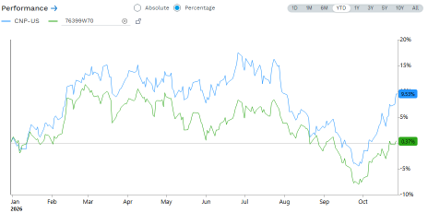
Source: FactSet
Overall, we think this print further amplifies our bullish view of CNP as full-year guidance improved, and management continues to commit to growth to meet demand through increased capital spending (some of which is front-loaded) while simultaneously taking a conservative approach.
Disclaimer: MacNicol & Associates Asset Management holds shares of CenterPoint Energy (CNP: NYSE) across various client accounts.
What we are watching next week
Next week is a crowded week for financial markets with a lot of potentially impactful events and data releases. The U.S. midterms land on Tuesday, which will impact the balance of power in Washington for the next two years. Historically, a balanced Washington is good for markets, which seems likely as of now. Beyond the election, investors will be watching trade policy between Canada and the U.S. as changes come into effect on October 30th. Progress seems limited on a trade deal (according to Canadian officials), but do not be surprised if yet another extension gets announced to the current tariff rates. Further tariff increases now would likely send inflation even higher. Currently, officials are negotiating steel and auto tariff relief. In terms of economic data, next Friday is a huge day for both Canada and the U.S. as both countries release their latest jobs data while inflation remains hot. These data points could help decide whether the FED and Bank of Canada hike rates in December. In terms of earnings, next week remains a very busy week with Apple, Palantir, AMD, Nutrien, Shopify, Suncor, and Manulife due to report their latest earnings.
MacNicol & Associates Asset Management
October 30th, 2026
Download in PDF format: