
Share This Post Today!


Chania Lighthouse, Crete, Greece

This lighthouse is an active lighthouse that originally was constructed in 1864. The 85-foot-tall structure was restored in 2006.
Patras Lighthouse, Patras, Greece

This lighthouse was first built in 1858 but was destroyed by a storm seven years later. The second lighthouse structure on this land was constructed in 1878 and stood until 1972. In 1999 Greece rebuilt the structure as a main sight and symbol of the city and does not have any maritime usage.
*Feel free to send us your photos of Lighthouses to be featured in our weekly market observations.
A reversal in the bond market
The imploding Treasury market, driven by rising yields, has led to massive inflows into the iShares 20+ Year Treasury Bond ETF over two days as investors bet on a short-term reversal. The iShares ETF has reportedly attracted $4.9 billion in inflows since last Friday as of Monday morning. Despite the recent inflows, the fund has posted negative year-to-date outflows. Last week the fund saw cumulative inflows of approximately $2.6 billion, the largest inflow for a week since early August (according to Barron’s).
The iShares long-dated Treasury fund closed at a record low on Friday, moved even lower on Monday and is on pace for its longest losing streak on record. The losses come as long-duration Treasuries have come under pressure with rising yields. The yield on the 10-year Note recently reached its highest level since mid-2002, hitting 5.3%. The 30-year yield also hit its highest level since 2002 on Wednesday as the global bond market sell-off continues. The 10-year has risen five weeks in a row, its longest such streak since 2024. According to analysts, investors are now piling into these long-dated fixed income funds for a few reasons, including bets on yields coming down and the outright attractiveness of these elevated coupons.

Image created with Grok
Yields moved higher on Monday after the ISM report showed a large proportion of service businesses reporting inflationary pressures (the highest since 2022). Unlike energy and food prices, services inflation historically is quite sticky and less cyclical. This is further evidence that inflation is spreading beyond the global energy industry and is being impacted by factors other than the conflict in the Middle East.
Investors expect interest rates to rise in the coming months at the short end of the curve, with a 25% expectation that the Federal Reserve will raise rates in October and a 25-basis-point hike fully priced by December. This comes as the FED raised rates for the first time in years at its September meeting early last month.
For four decades, interest rates moved lower across the world. They bottomed in 2020 during Covid-19 when the global economy was shut down. At this time, interest rates were nearly 0%, down from mid-teens interest rates in the early 80s. The compression of interest rates allowed equity and fixed income investors to reap major benefits, it was the largest bull market in history. Fast forward six years and rates have reversed their downward move and are complicating financial markets for many investors. Many are arguing that rates will remain elevated for a while as the world combats persistent inflation, which looks to be stickier than it has been in decades. We are not sure which way things go but have a sneaking suspicion that in the long run rates will likely be higher due to the deteriorating fiscal situation in the U.S. and across the world.
Oil sands deal activity heats up
A few months ago, we wrote about Shell acquiring Canadian energy firm Arc Resources. We highlighted this deal for a few reasons: one, some of our clients held Arc Resources shares, and two, the reasons why this transaction was made: increased demand for Canadian energy assets. The assets Shell acquired expand its natural gas reserves that will feed an existing Shell facility in British Columbia. We will not go any deeper, as we covered the deal in past editions of this commentary. We bring this up this week as there was another deal announced in the Canadian energy sector which caught our eye.
On Monday, Cenovus announced that it reached an agreement to buy Athabasca Oil in a $5.7 billion cash and stock deal. Cenovus offered roughly $12 per share, a 13.4% premium to the stock’s closing price on the TSX on Friday. Athabasca shares have been on fire in recent years and have increased 71% year-to-date. Cenovus shares moved lower on Monday by 2% after this announcement.
The acquisition further cements Cenovus position in the Canadian energy industry as one of the largest oil sands producers. It also comes a year after Cenovus made another large acquisition in the oil sands. The acquisition of the independent Athabasca further consolidates the oil sands sector at a time when the country is looking to boost production.
The deal adds approximately 45,000 barrels of oil equivalent per day to Cenovus’s oil sands production. Cenovus stated that the assets could be expanded to produce up to 115,000 barrels per day by 2032. In the second quarter of this year, Cenovus’s total upstream production totaled 970,000 barrels of oil equivalent per day. Analysts believe Cenovus paid a premium for these assets, and the acquisition was driven by management’s confidence in its ability to advance proposed oil sands growth projects and their belief in the future of expanded production across the oil sands.
This deal highlights the premium firms are willing to pay for Canadian energy assets in today’s market. Countries are looking to Canada to diversify their energy supply as it is seen as a clean, reliable, and low-cost solution. Disruptions driven by conflict and tariffs across the world in recent years have impacted the flow of energy to numerous countries that are energy importers. These countries naturally have looked to diversify their supply so that does not happen again.
We also think policy changes are driving this acquisition trend, as Prime Minister Carney has made sweeping changes to policies that remove barriers in the fossil fuels industry. Last week, Carney even announced that he will look to fast-track the approval process for a new proposed crude oil pipeline to the Pacific coast, which would allow Canadian producers to increase their current production. The announcement does not come free for the oil sands industry, as the project’s approval reportedly depends on oil sands companies making investments for large-scale carbon capture storage projects. Companies in the oil sands have not yet decided if they will meet Carney’s request to get their pipeline greenlit.
It is great to see more and more of these deals happening in Canada, especially as investment managers with exposure across the North American energy landscape.
We will say it is interesting that Cenovus made this deal now, after Athabasca shares have substantially rallied.
Oil manipulation
As oil and energy prices as a whole remain elevated due to the ongoing conflict in the Middle East, which resulted in the closure of the Strait of Hormuz and its slow reopening, officials are reportedly considering new oil and diesel reserve releases to elevate price pressure. Countries around the world have tapped their reserves throughout this year to nullify the impact the conflict in Iran had had on energy prices. Despite these efforts, oil prices remain in the $90 range and are severely impacting consumers and enterprises, which are seeing rising prices.
This week, the International Energy Agency and the European Union were reportedly discussing an oil and diesel stock release. This comes a few days after the Group of 7 countries agreed on Friday to release 100 million barrels of their strategic reserves after President Trump stated that he may consider banning U.S. exports of diesel amid shortages if they did not put more fuel into the market.
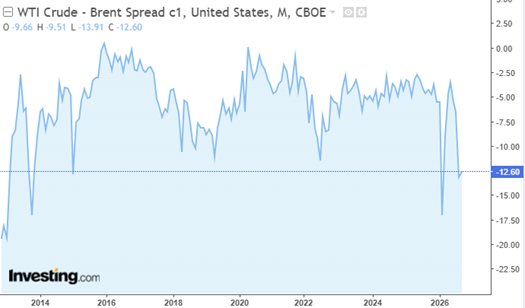
These discussions are not simply due to a crude oil spike; there is more to diesel. Diesel prices across the world have been soaring this year as supply continues to tighten due to disrupted product flows and refinery constraints. Over the last month, European diesel prices moved up by another 13%. Diesel margins recently hit record highs even when oil prices retreated. U.S. and international oil prices have also diverged in recent months due to lost supply and flow constraints. The price differential is a freight and risk differential in the eyes of many analysts due to where the oil needs to flow through. WTI is a measure for U.S. oil, and Brent is a common measure for international oil markets. The Crude-Brent spread currently sits at its largest level in over ten years, other than over a few weeks at the start of this year when the Iran conflict began.
Source: Investing.com
Although oil prices pulled back late on Wednesday after these reports, early trading reflected the pattern that energy prices have exhibited this year: any report or announcement of energy stockpiles is generally followed by a price increase.
Despite last week’s G-7 announcement, it is unclear how much oil and diesel will be released. The Polish Energy Minister stated that Poland was ready on Wednesday to release oil and diesel stocks if a consensus was reached but did not expect a decision from the IEA that day.
This potential release by the IEA comes after it released 400 million barrels of oil from strategic stockpiles in March (the largest in history). So far, 325 million barrels have been released into the market. EU officials expect the remaining oil from the March announcement to count towards this potential 100-million-barrel plan. JP Morgan analysts stated that last Friday’s announcement by the G7 should not be taken lightly as it likely includes previously announced but not yet released reserves.
The U.S. government energy statistics agency raised its price outlook sharply this week. The EIA projected that Brent would average $105 a barrel in the fourth quarter, $14 higher than its forecast last month.
We remain bullish on oil prices and the energy sector. We continue to hold and look for high-quality energy names so we can remain overweight relative to indices. Many of the energy producers that we hold are producing very attractive cash flows at these price levels. However, if prices spike higher, we could reach the demand destruction range, which would negatively impact production and cash flows for energy producers as well as economic growth for many countries. We will continue to watch this very closely.
Disclaimer: MacNicol & Associates Asset Management own shares of companies across various client accounts classified as energy companies by classification system companies.
More deals, this time in Canadian utilities
This week, a massive deal was announced between two Canadian utility companies, Halifax-based Emera and Calgary-headquartered ATCO. The deal caught our eye as we have long liked ATCO and have exposure to the company across various client accounts.
Onto the deal….
The deal, which was announced on Tuesday, will merge Emera with Canadian Utilities, which is controlled by ATCO, to create a Canadian utility powerhouse. The deal will create a company with an enterprise value of $72 billion. According to Yahoo, this deal is the largest merger in history between two Canadian companies. The combined company will be one of the top 20 largest utility companies in North America. The firm will operate as Emera after the deal closes and will serve approximately 6 million customers, with 80% of earnings expected to come from Florida and Alberta, two growth markets. Currently, Emera sources 70% of its EPS from Florida while ATCO sources 80% from its operations in Alberta.
Under the terms of the deal ATCO Class I and II shareholders will receive 0.865 of an Emera share plus one new ATCO share for each share held. ATCO will spin off its industrial services business and focus on housing, defense and investments (including retail energy and ports). The new ATCO will also be public. Emera shareholders will own approximately 60% of the new company. The transaction is expected to be accretive to adjusted EPS in the first full year after the deal closes.
Emera’s CEO stated that this powerhouse will help power Canada’s growth ambitions and will look to benefit from the electrification trends and major infrastructure development across Canada. According to management, the new company will benefit from scale in its capital-intensive projects, electrification projects, major natural gas and electric transmission projects, large load customers, export infrastructure, and other large-scale energy infrastructure projects.
The deal is expected to close in the third or fourth quarter of next year.
ATCO shares moved much higher on this announcement on Tuesday and are up 44% so far in 2026. The firm has provided a blend of growth and income to shareholders over the last few years as management unlocked further value. As of 2026, management has raised ATCO’s annual dividend 33 years in a row. The firm’s payout ratio sits in the 50% range in terms of adjusted EPS due to its stable regulated utility cash flows. Emera shares, on the other hand, pulled back on Tuesday and are down 3% this year (as of Wednesday afternoon). Emera shares are more attractive from a fundamental standpoint but currently are not a buy in our eyes. We are going to continue to analyze this deal as its approval process gets underway so we can make the most informed decision for our investors.
From an ATCO shareholder standpoint, we like this deal as it unlocks value for shareholders and creates two clear platforms which investors can assess. The deal also raises ATCO’s dividend by 20% with a more diverse geographic footprint in terms of the combined firm’s utility platform. In terms of ATCO’s new firm, shareholders will get access to a more focused, growth-oriented platform which will deploy capital into housing, defense, and real assets. The firm already has a strong track record in each of these areas and will look to attract a more focused investor base moving forward. Over the last five years, ATCO has grown its adjusted earnings ex. Canadian utility earnings at a 25% CAGR, reflecting a strong existing platform and management team.
We will continue to report on this deal as we sift through the details.
Disclaimer: MacNicol & Associates Asset Management holds shares of ATCO (ACO.X: TSX) across various client accounts.
What we are watching next week
After taking a week off this commentary, we have a lot to comment on. Markets have been relatively flat over the last two weeks, and volatility remains near 52-week lows despite investor worry, deteriorating sentiment, and rising yields. We will be watching yields very closely next week to see if there is any change to the upward trend that we have seen in yields over the last few months. This upward yield trend at the long end of the curve has led to a sharp bond sell-off, which has made many bond ETFs, mutual funds, and investment vehicles become heavily oversold.
As we head into next week, we want to wish our Canadian readers a Happy Thanksgiving and wish you a great holiday weekend. After the long weekend, there are a few major events that we will be watching very closely, including the resumption of earnings season, with numerous Wall Street banks due to report earnings next week, beginning on Tuesday. On the macro side, we will be watching numerous economic data releases, including the U.S. CPI on Wednesday, and retail sales data, the PPI report, and jobless claims on Thursday. All of these events will have rippling effects on equity and debt markets, FED policy, and asset allocation.
MacNicol & Associates Asset Management
October 9th, 2026