
Punta Penna Lighthouse, Abruzzo, Italy

This lighthouse was originally built in 1906 but was reconstructed in the mid 1940s after the German army destroyed it in 1944. The lighthouse stands at 230 feet tall.
Planier Light, Marseille, France

This lighthouse was originally built in 1959 and stands at 216 feet tall. The lighthouse is the 4th tallest in France.
*Feel free to send us your photos of Lighthouses to be featured in our weekly market observations.
Trade turmoil
Markets moved lower early on Monday on renewed trade worries. Equity markets, cryptocurrencies, and even some commodities moved lower on Monday after Trump increased the global tariff rate to 15% after a Supreme Court ruling on Friday. The Supreme Court ruled against Trump’s tariffs in a hearing on Friday. However, Trump condemned the ruling, stating that he was deeply disappointed. The ruling affects more than 60% of the revenue collected by the tariffs so far.
The White House has stated that the 15% tariff rate is temporary and that the administration plans to utilize different legal authorities to continue the president’s tariff regime.
Another important wrinkle from this topic is that the Supreme Court’s ruling on Friday essentially nullifies all the trade deals the U.S. government has inked so far. The U.S. has signed numerous trade deals, including with India, Japan, and the UK.
Trade uncertainty has reemerged and will more than likely lead to fragile markets, especially as investors look for consistency and guidance, two things President Trump is not clear on.
Berkshire post Buffett
After Warren Buffett officially retired on December 31st, 2025, as CEO of Berkshire Hathaway, we are in a new world. The Oracle of Omaha is a legend, and the company will never be the same, no offense to Greg Abel. In Buffett’s last quarter as CEO, it was reported that he further reduced Berkshire’s exposure to Apple by selling 4.3%. Berkshire has reduced its Apple exposure by more than 75% since the summer of 2023. Berkshire’s largest buys over the last quarter were Chevron and Chubb.
Abel’s taking over comes at an interesting time. Berkshire’s cash reserves sit at all-time highs and are approaching $400 billion. This is enough cash to buy 382 companies in the S&P 500.
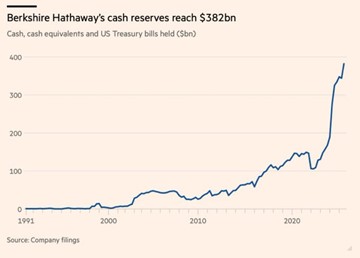
Many had speculated for years what Buffett’s next big buy would be, and he never made one. Berkshire’s market capitalization sits at $1 trillion; they are almost 40% cash. The company’s investment portfolio includes $274 billion in public securities. The remaining value comes from private companies and partnerships that Berkshire owns. The companies include Geico, Dairy Queen, Sees Candies, BNSF Railway, and Berkshire Hathaway Energy.
Abel made a move this month in his first quarter as CEO, as he completed the sale of energy assets in Washington state to Portland General Electric for $1.9 billion. The company sold energy assets through PacificCorp, a utility it owns through Berkshire Energy. The company cited liquidity concerns as a reason for the transaction, as it battles with wildfire litigation in Oregon. This is a rare move by Berkshire as it rarely has sold a large asset of this size through one of its subsidiaries. Abel previously led PacifiCorp’s immediate parent Berkshire Hathaway Energy for about a decade. The sale does not include PacifiCorp’s hydroelectric generation facilities in Washington.
As we move forward, we will continue to watch Abel and Berkshire closely. It will be impossible to fill the shoes of Warren Buffett and his late partner Charlie Munger’s, but there is a lot of capital that has been sidelined for quite some time, and said capital could impact sectors or industries as a whole in a meaningful way.
Disclaimer: MacNicol & Associates Asset Management holds shares of Berkshire Hathaway across various client accounts.
Warner Bros news heats up
This week, one of Warner Bros Discovery’s suitors made a fresh offer to acquire the media giant. Netflix and Paramount have been sparring for some time over Warner Bros Discovery assets. The Warner board has backed the Netflix deal, but that is not stopping Paramount.
Paramount made a fresh offer for all of Warner Bros Discovery as it bids to one-up Netflix. Warner Bros Discovery leadership stated that they are reviewing the new offer from Paramount. For now, the board will still back the Netflix offer but will update shareholders accordingly. Warner was in talks with Paramount last week and gave the company until this past Monday to submit its final offer. According to the BBC, Paramount increased its acquisition offer by $1/share. Polymarket odds point to Paramount actually being in the driver’s seat regarding a Warner Bros Discovery deal (53% odds that Paramount acquires Warner Bros assets).
It has also agreed to pay $7 billion should the deal fall through and cover the $2.8 billion fee Warner Bros had agreed to pay Netflix in the event of a break-up of the merger plan. Netflix has four days to match or beat a Paramount deal if Warner Bros decides to go with a Paramount deal.
Many have turned bullish on Netflix shares in recent months as shares have pulled back. Sell-side investment banks have raised their target prices for Netflix shares in recent months. The belief is that a larger content library will help support monetization through advertising and engagement. The termination payment also protects Netflix shareholders in the case of Warner Bros backing out and making a deal with Paramount.
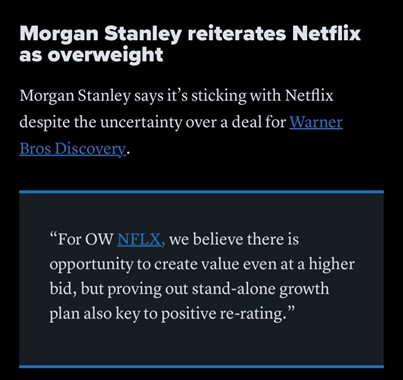
Despite this case, we are bearish on Netflix due to its structural slowing growth, high content spending, and elevated valuation (Netflix trades at a trailing-12-month P/E ratio of 30x).
Heavy stocks > capital light
According to two Goldman Sachs indices, capital-heavy stocks are outperforming (and have been for quite some time) capital-light companies:
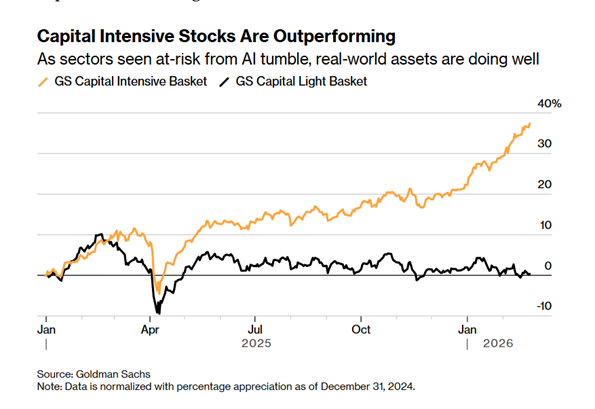
This trend is being driven by AI and correlates with the software bubble burst, where SaaS companies are struggling. Software companies are amongst the most capital-light companies in the world.
Analysts have labeled the heavy capital outperformance the HALO effect (heavy assets and low obsolescence). Heavy assets and low obsolescence describe sectors like basic materials, energy, and utilities. Stocks that have assets that are hard to replicate and are less exposed to technological obsolescence.
We expect this trend to accelerate. Firms like Nvidia, Meta, and Alphabet, which were once capital-light, are now considered capital-heavy due to their heavy spending on capex for AI over the last few years.
Gold demand surging
India reported another record for gold imports to end 2025. Gold demand continues to remain robust as investors and Central Banks look to diversify their holdings away from U.S. Dollar assets and seek to hedge various risk factors prevalent across todays financial and economic landscape.
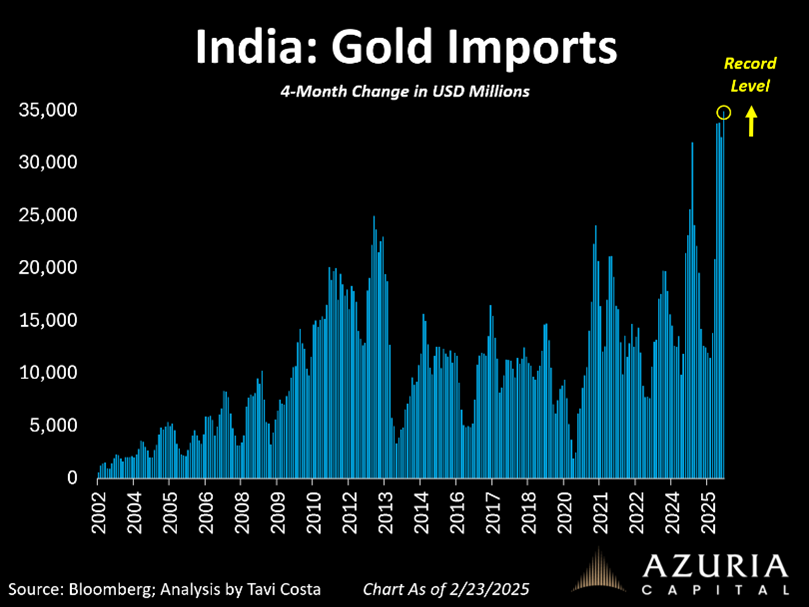
India is one of the largest importers of gold in the world. Demand from India comes from physical consumption and investment purposes.
Physical gold accumulation speaks louder than investment strategist narratives. This trend is occurring around the world and is just beginning.
Canadian banks report
BMO and National Bank reported their latest earnings on Wednesday, and both firms reported strong numbers. Both firms saw their profits rise YoY. Scotiabank reported similar numbers on Tuesday as the Canadian banks kick off their first earnings report for 2026.
BMO’s profit rose from $2.14 billion to $2.49 billion YoY despite a large severance charge. BMO’s strong numbers were driven by fee growth and margin expansions in both its Canadian and American business units. National Bank’s double beat was driven by its recent acquisition of Canadian Western Bank. The bank’s wealth management business earned $272 million, up from $242 million in the same quarter last year, while its capital markets business earned $443 million, up from $417 million a year earlier.
Scotiabank also reported a double beat as adjusted earnings-per-share came in at $2.05 versus consensus estimates of $1.95. Scotiabank’s leadership stated that 2026 is off to a strong start, and the recent earnings growth was driven by all business units. Scotiabank’s international earnings and wealth management earnings both jumped year-over-year and helped drive the earnings expansion.
RRSP deadline
For our Canadian investors, we wanted to remind you that the 2025 RRSP contribution deadline is Monday, March 2, 2026. Contributions made between January 1, 2026, and March 2, 2026, can be deducted on your 2025 tax return. The 2025 RRSP contribution limit is $32,490, or 18% of your 2024 earned income, whichever is less.
We also wanted to remind our investors that 2026 is a new year, and that means new TFSA and FHSA contribution room. Investors can top up their TFSAs with $7,000 and their FHSAs with $8,000 in 2026. Contact the CRA or check your latest Notice of Assessment to see your official contribution limit.
Our product offerings go beyond traditional registered accounts including the Personal Pension Plan. We have a growing number of Personal Pension Plans, so if you are a PPP holder contact us today to contribute to your plan. If you are the owner of a successful business, the PPP is the best game in town. Here is a graphical illustration of the benefits of a personal pension plan versus a RRSP:
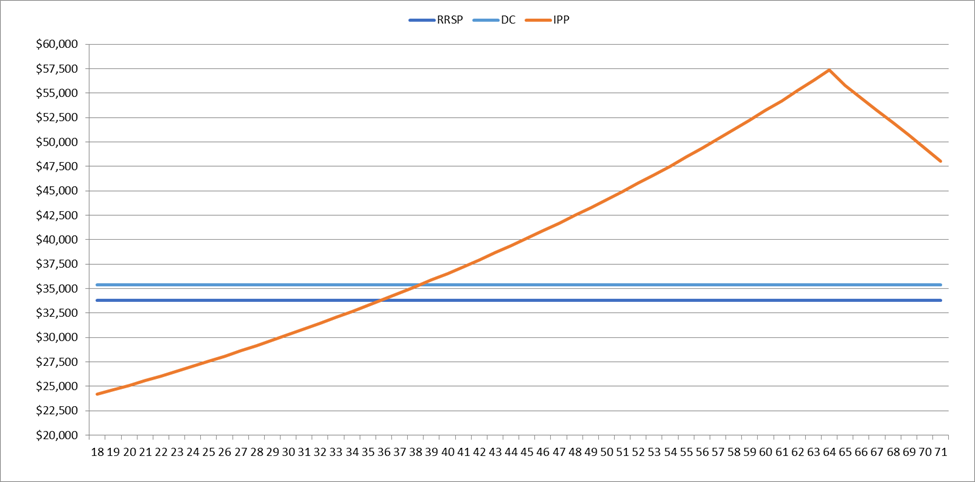
The dark blue is the RRSP maximum limit for 2026. Under the PPP, the light blue represents the DC contribution maximum and past age 40, the orange line are the DB limits. As you can see graphically, at every age, someone in a PPP is contributing more than under an RRSP. By age 64, the gap in favour of the PPP is over $20,000 more than the maximum allowed under an RRSP.
What we are looking at next week:
The market enters the week of March 2 with no end in sight to the choppy, sideways action we have been in for more than a full quarter now. The earnings release from NVDA did nothing to push the market one way or another, with the stock’s double beat resulting in a sell-off that did not cascade materially to the broader market. As we have mentioned before, given the expensive valuations we are currently seeing, any breakout to the upside next week would be something that investors would likely observe with cautious optimism.
February 27, 2026
MacNicol & Associates Asset Management
Download in PDF format: